
home
about/contact
Digital Audio Insider is David Harrell's blog about the economics of music and other digital content. I write from the perspective of a musican who has self-released four albums with the indie rock band the Layaways.
My personal website has links to my LinkedIn and Google+ pages and you can send e-mail to david [at] thelayaways [dot] com.
As an Amazon Associate I earn from qualifying purchases.
Support
If you enjoy this site, please consider downloading a Layaways track or album from iTunes, Amazon MP3, Bandcamp, or eMusic. CDs are available from CD Baby and Amazon.
links
music/media/tech:
Analog Industries
Ars Technica
AppleInsider
Brad Sucks Blog
Broken Record
Digital Music News
Duke Listens
Future of Music Coalition Blog
Hypebot
LA Times Technology Blog
The ListeNerd
Medialoper
Mediashift
MP3 Insider
Music Ally
Music Machinery
Music Think Tank
MusicTank
The Music Void
New Music Strategies
Online Fandom
Pakman's Blog
RAIN
Rough Type
RoughlyDrafted
Swindleeeee
TuneTuzer
Virtual Economics
economics/markets:
The Big Picture
Core Economics
Freakonomics
The Long Tail
Marginal Revolution
The Undercover Economist
mp3/music:
17 Dots
3hive
Fingertips
Shake Your Fist
Sounds Like the 80s
Unleash the Love
archives
January 2006
February 2006
March 2006
April 2006
May 2006
June 2006
July 2006
August 2006
September 2006
October 2006
November 2006
December 2006
January 2007
February 2007
March 2007
April 2007
May 2007
June 2007
July 2007
August 2007
September 2007
October 2007
November 2007
December 2007
January 2008
February 2008
March 2008
April 2008
May 2008
June 2008
July 2008
August 2008
September 2008
October 2008
November 2008
December 2008
January 2009
February 2009
March 2009
April 2009
May 2009
June 2009
July 2009
August 2009
September 2009
October 2009
November 2009
December 2009
January 2010
February 2010
March 2010
April 2010
May 2010
June 2010
July 2010
September 2010
October 2010
November 2010
December 2010
January 2011
February 2011
March 2011
April 2011
May 2011
June 2011
July 2011
August 2011
September 2011
October 2011
November 2011
December 2011
January 2012
February 2012
April 2012
May 2012
June 2012
August 2012
October 2012
November 2012
December 2012
January 2013
February 2013
March 2013
June 2013
August 2013
February 2014
March 2014
September 2014
December 2014
March 2015
October 2015
November 2015
December 2015
October 2016
May 2017
May 2025
February 28, 2014
Does iTunes Radio Increase Music Sales?by David Harrell
Back in 2009, my band the Layaways released a digital-only holiday album. While we sell some tracks from the album every year, 2013 was, by far, our best season ever for download sales. I was stumped -- we always get some holiday airplay on Internet stations like Soma FM and the occasional spin of a few tracks on terrestrial college radio stations, but there was no evidence of increased airplay in 2013 and we hadn't made any additional promotional efforts for the album.
The mystery was solved when someone tweeted that he had discovered the record via iTunes Radio. Our version of "O Christmas Tree" had been added to the "Rockin' Holiday" station, where it was receiving regular spins:
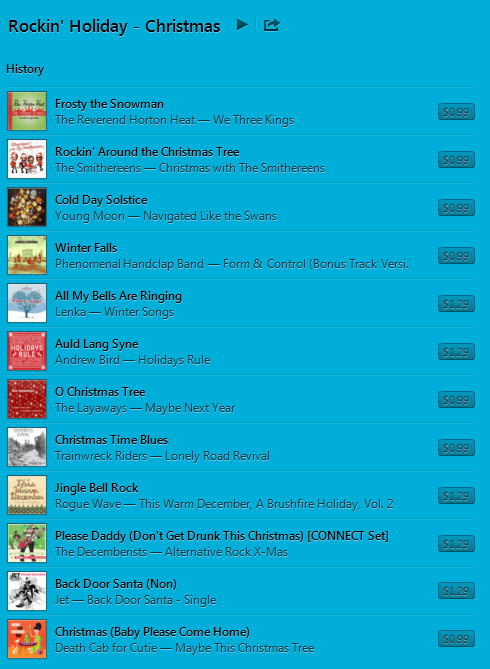
It seems very likely that the large increase in sales of our song (relative to previous years) was a direct result of the iTunes Radio spins it received. The big question, of course, is does this single anecdotal example represent an overall trend -- is iTunes Radio increasing the sales of music downloads?
It seems intuitive that ease of purchase -- you're already in iTunes and you can click to buy right there, as opposed to being directed from another website or interface to iTunes or Amazon MP3 -- might boost sales. Yet that doesn't appear to be the case. As Glenn Peoples reported in Billboard last year, the introduction of iTunes Radio did nothing to halt a year-long trend of declining download sales in 2013.
In our case, iTunes Radio was a net positive, because more than 100,000 listeners heard a song they probably wouldn't have otherwise known about, and a small percentage of those listeners purchased the track. But as noted in Billboard, a recent study by Music Forecasting makes the case that listeners are using iTunes Radio for a "lean-back" passive listening experience, one that is unlikely to result in large increases in music purchases. (The full PDF of the report is here.)
In addition to the download sales, we also received a payout from Apple for each spin of the song. As reported last year by the Future of Music Coalition and Digital Music News, Apple opted to make a direct payment to artists/labels for digital performance royalties instead of taking the compulsory path and making payments to SoundExchange.
For 103,874 spins of "O Christmas Tree" on iTunes Radio, we received $114.99 (before the deduction for CD Baby's commission). That translates to a little more than 0.11 cents per play. That's slightly less than the "$0.0013 per song plus 15% of net advertising revenue for the first year" spelled out by Apple's contract with indie labels, though I'm uncertain if that rate also includes payments Apple makes to music publishers. After I receive my BMI statement for the quarter, I can calculate the total payment we received for each iTunes Radio play.
Labels: Apple, holiday music, iTunes Radio, music sales
link 0 comments e-mail listen to the Layaways on SpotifyFollow @digitalaudio Tweet
August 26, 2013
Some Advice for Writers...by David Harrell
...that probably goes for musicians as well:
"Also get a job; eating is a good habit and you will never make enough of a living as a writer to support a family. Be honest with yourself about the size of your gift. Expect no money but be diligent about sending pieces out for publication. All money is gravy."-- Brian Doyle, via the Dish.
One downside of digital music stores, which provided instant worldwide music distribution to anyone who wanted it, is that they also introduced a new level of expectations for musicians. Before digital music, a local band might sell some tapes or CDs at gigs or a friendly record store, but there was zero expectation that music sales would provide any real income. However, having your music available to the entire world creates the hope that people around the world are going to buy it. Yet the overwhelming majority of self-released musicians (as well as most musicians on major labels!) simply aren't going to sell a lot of music.
Labels: music sales, self-released musicians
link 0 comments e-mail listen to the Layaways on SpotifyFollow @digitalaudio Tweet
June 17, 2013
I'm In with the In Crowdby David Harrell
A presentation by Alan B. Krueger, Chairman of the Council of Economic Advisers for the White House, highlights an experiment that confirms something I've long believed to be true -- that listener perceptions of the popularity of a song have a huge influence on its actual/subsequent popularity:
Now let's see what happened when the download counts were flipped, so that the new participants thought the least popular song was actually the most popular. As you can see, the download count for the least popular song grew much more quickly when it was artificially placed at the top of the list. And the download count for the most popular song grew much more slowly when it was artificially placed at the bottom of the list.More good stuff here.
In the alternative world that began with the true rankings reversed, the least popular song did surprisingly well, and, in fact, held onto its artificially bestowed top ranking. The most popular song rose in the rankings, so fundamental quality did have some effect. But, overall -- across all 48 songs -- the final ranking from the experiment that began with the reversed popularity ordering bore absolutely no relationship to the final ranking from the experiment that began with the true ordering. This demonstrates that the belief that a song is popular has a profound effect on its popularity, even if it wasn't truly popular to start with.
Labels: consumer behavior, music popularity
link 0 comments e-mail listen to the Layaways on SpotifyFollow @digitalaudio Tweet
March 05, 2013
Tuesday Odds and Ends: A YouTube Music Streaming Serviceby David Harrell
YouTube is already the largest music-streaming platform, but it looks like it will launch a dedicated Spotify-style streaming service.
Felix Salmon on Amanda Palmer's TED Talk and content economics:
There are basically three ways to go about this. You can put up a paywall; you can ask for donations; or you can sell non-digital things to your digital audience.Nicholas Carr highlights another study showing that students prefer paper textbooks to digital versions, despite the seeming advantages of the latter format (portability, interactivity, etc.):
On its face, Palmer's talk is about the second strategy, but in fact it's about all three. (And yes, I’m the "financial blogger" referred to in the talk.) For instance, when it comes to online publishing, why are paywalls more common than tip jars, despite the fact that they're much more difficult to implement? Palmer does a great job of walking us through the answer to that question: there's something shameful, there's a whiff of the panhandler, in asking strangers for money.
However, researchers often overlook students' personal beliefs about how they learn and study most effectively. Their resistance to replacing paper textbooks with e-textbooks together with an ongoing desire to be able to print electronic content suggests that paper-based information serves students' needs better in the educational context.And if you missed it, this Music Ally story from last month rounds up a slew of reports on artist payments from Spotify (including ones from this blog).
Labels: ebooks, music streaming, Spotify, YouTube
link 0 comments e-mail listen to the Layaways on SpotifyFollow @digitalaudio Tweet
February 11, 2013
Monday Odds and Endsby David Harrell
Amazon has received a patent for a method of selling "used" digital files. More coverage from Wired and a statement from ReDigi. (The firm had previously indicated that it would roll out a marketplace for pre-owned digital books.)
Is Apple testing an IOS-powered watch?
The Businessweek story on Doug Morris.
And the Gizmodo story on how Monster Cable, the lawsuit-happy purveyor of expensive audio and video cables, fared poorly in its business relationship with Beats Audio.
Labels: Amazon, Doug Morris, Monster Cable, used digital content
link 0 comments e-mail listen to the Layaways on SpotifyFollow @digitalaudio Tweet
February 08, 2013
Friday Flashback Fun: The Cars Perform "Let's Go" in 1979by David Harrell
The Cars perform one of my all-time favorite songs during a 1979 appearance on the Midnight Special:
Labels: 1970s, 1979, Friday Flashback Fun, The Cars
link 0 comments e-mail listen to the Layaways on SpotifyFollow @digitalaudio Tweet
February 06, 2013
Wednesday Odds and Endsby David Harrell
My Bloody Valentine is selling its new album (its first in TWENTY TWO years) direct to fans. The digital version is album-only, with a fixed price ($16) for your choice of three file format choices:
16bit 44.1 K WAV - This is CD quality with no digital compression. i.e. it's exactly like a CD. This format may not be compatible with some devices.Meanwhile Prince is hawking his latest singles for 88 cents a track.
320kbps MP3 - This format is compatible with most devices.
24bit 96 K WAV - This format may not be compatible with some devices.
Audiogalaxy (recently acquired by Dropbox) pulled the plug on its music streaming app.
In the WSJ, discovering music via fitness classes -- Vanilla Ice attempts to cash in:
Zumba fans have already helped revive the career of Rob VanWinkle -- better known as the rapper Vanilla Ice. Last year, Mr. VanWinkle rerecorded his 1990s hit "Ice Ice Baby" with a Latin flavor and Zumba-friendly tempo, then starred in a video featuring Zumba choreography. Released last August, the single has sold nearly 17,000 copies.And the Atlantic has the audio of the oldest playable recording, from 1878. The rhythmic noises at the beginning (the foil was stored folded for more than a century) make it sound vaguely techno.
Labels: Audiogalaxy, My Bloody Valentine
link 0 comments e-mail listen to the Layaways on SpotifyFollow @digitalaudio Tweet
January 30, 2013
A Few Quick Thoughts on the NY Times Spotify Articleby David Harrell

I know I've promised a long-form post on Spotify, but in the meantime, some quick observations on this week's NY Times article on the economics of music streaming:
1. Mainstream press -- please don't conflate streaming services with personalized Internet radio ("...as listeners begin to move from CDs and downloads to streaming services like Spotify, Pandora and YouTube."). Spotify and Pandora are cousins, not siblings.
2. With all due respect to Sean Parker, the glory days of music sales in 1990s aren't coming back. It was a unique time, when consumers were willing to repurchase music they already owned (on LP and cassette) in a more-expensive format (CD). Even if a magical new format is rolled out, one that makes average consumers want to upgrade, my guess is that many of them would manage to acquire the content without paying for it.
3. To its credit, the article does mention (but doesn't emphasize) what I think is the most important point about the Spotify model -- the coupling of artist/label compensation with listener consumption, as opposed to consumers pre-paying for a lifetime of listening via the purchase of a download or CD:
"Unlike the royalties from a sale, these payments accrue every time a listener clicks on a song, year after year."4. The per-play amounts paid to artists/labels are, as everyone knows, quite small. As noted in the article, self-released artist Zoe Keating reports an average payment of 0.42 cents per play. When you adjust that number for the 9% commission she pays to CD Baby, you end with 0.47 cents, which is almost identical to the most recent numbers I've posted here for Spotify plays of the Layaways.
Should Spotify pay more? In an ideal world it would, but the company is currently paying 70% of its revenue to rights holders and publishers. In addition to the freebie service, it offers two subscription tiers in the U.S. -- $4.99 a month for an ad-free service and $9.99 a month premium service with higher sound quality and a mobile option. Based on a 0.47 cents figure (and assuming that the current mix of free, $4.99, and $9.99 subscribers remained stable) Spotify would need to increase its U.S. subscription prices to $10.62 and $21.26 to accommodate a one cent per-play payout.
That larger number is still less than the $30 that Sam Broe, the 26-year-old music fan quoted at the beginning of the article, used to spend each month on music purchases before becoming a Spotify subscriber. But would he -- and other current/potential Spotify subscribers -- be willing to pay it?
Labels: music streaming, music subscriptions, Spotify
link 1 comments e-mail listen to the Layaways on SpotifyFollow @digitalaudio Tweet
More Digital Audio Insider: Newer Posts Older Posts
Subscribe:
 RSS Feed
Add this blog to Del.icio.us, Digg, or Furl. Follow David Harrell on Google+.
The Digital Audio Insider Twitter feed:
Digital music jobs: Looking to hire? Looking for a job? Check out the digital audio insider job board.
Popular Posts
A Long Tail Experiment
By the Numbers: Using Last.fm Statistics to Quantify Audience Devotion
Lala.com Owes Me Sixty Cents
An Interview with Jonathan Segel of Camper Van Beethoven
Price Elasticity of Demand for McCartney
Sony and eMusic: What I Missed
The Digital Pricing Conundrum series:
Part One Part Two Part Three Part Four
THE LAYAWAYS
Out Now -- "Maybe Next Year" -- The New Holiday Album:
"This is a sweet treat, deliciously musical without being overbaked for mass media consumption." -- Hyperbolium
"Perfect listening to accompany whatever holiday preparations you may be making today." -- Bag of Songs
O Christmas Tree - free mp3 lyrics and song details
Away In A Manger - free mp3
Download from eMusic, iTunes, Amazon MP3, or Bandcamp. Listen to free streams at Last.fm.

"...about as melodic and hooky as indie pop can get." -- Absolute Powerpop
"Their laid-back, '60s era sounds are absolutely delightening." -- 3hive
"...melodic, garage-influenced shoegaze." -- RCRD LBL
Where The Conversation Ends - free mp3
January - free mp3
Keep It To Yourself - free mp3
Download from eMusic, iTunes, Amazon MP3, or CD Baby, stream it at Last.fm or Napster.

"The Layaways make fine indie pop. Hushed vocals interweave with understated buzzing guitars. The whole LP is a revelation from the start." -- Lost Music
"Catchy Guided by Voices-like rockers who lay it on sweetly and sincerely, just like Lionel Richie." -- WRUV Radio
Silence - free mp3 lyrics and song details
The Long Night - free mp3
Download from eMusic, Amazon MP3, or iTunes, stream it at Last.fm, Napster, or Rhapsody.

"These are songs that you want to take home with you, curl up with, hold them close -- and pray that they are still with you when you wake up." -- The Big Takeover
Let Me In - free mp3
Ocean Blue - free mp3
Download from eMusic, Amazon MP3, or iTunes, stream it at Last.fm, Napster, or Rhapsody.
More Layaways downloads:


the layaways website