
home
about/contact
Digital Audio Insider is David Harrell's blog about the economics of music and other digital content. I write from the perspective of a musican who has self-released four albums with the indie rock band the Layaways.
My personal website has links to my LinkedIn and Google+ pages and you can send e-mail to david [at] thelayaways [dot] com.
As an Amazon Associate I earn from qualifying purchases.
Support
If you enjoy this site, please consider downloading a Layaways track or album from iTunes, Amazon MP3, Bandcamp, or eMusic. CDs are available from CD Baby and Amazon.
links
music/media/tech:
Analog Industries
Ars Technica
AppleInsider
Brad Sucks Blog
Broken Record
Digital Music News
Duke Listens
Future of Music Coalition Blog
Hypebot
LA Times Technology Blog
The ListeNerd
Medialoper
Mediashift
MP3 Insider
Music Ally
Music Machinery
Music Think Tank
MusicTank
The Music Void
New Music Strategies
Online Fandom
Pakman's Blog
RAIN
Rough Type
RoughlyDrafted
Swindleeeee
TuneTuzer
Virtual Economics
economics/markets:
The Big Picture
Core Economics
Freakonomics
The Long Tail
Marginal Revolution
The Undercover Economist
mp3/music:
17 Dots
3hive
Fingertips
Shake Your Fist
Sounds Like the 80s
Unleash the Love
archives
January 2006
February 2006
March 2006
April 2006
May 2006
June 2006
July 2006
August 2006
September 2006
October 2006
November 2006
December 2006
January 2007
February 2007
March 2007
April 2007
May 2007
June 2007
July 2007
August 2007
September 2007
October 2007
November 2007
December 2007
January 2008
February 2008
March 2008
April 2008
May 2008
June 2008
July 2008
August 2008
September 2008
October 2008
November 2008
December 2008
January 2009
February 2009
March 2009
April 2009
May 2009
June 2009
July 2009
August 2009
September 2009
October 2009
November 2009
December 2009
January 2010
February 2010
March 2010
April 2010
May 2010
June 2010
July 2010
September 2010
October 2010
November 2010
December 2010
January 2011
February 2011
March 2011
April 2011
May 2011
June 2011
July 2011
August 2011
September 2011
October 2011
November 2011
December 2011
January 2012
February 2012
April 2012
May 2012
June 2012
August 2012
October 2012
November 2012
December 2012
January 2013
February 2013
March 2013
June 2013
August 2013
February 2014
March 2014
September 2014
December 2014
March 2015
October 2015
November 2015
December 2015
October 2016
May 2017
May 2025
March 16, 2015
Beats Music Beats Spotifyby David Harrell
In terms of subscribers and market share, Beats Music (acquired by Apple as part of its purchase of Beats in May of last year) is way behind Spotify. But there's one area where Beats Music appears to be ahead -- the per-stream payout to artists/labels.
The first payouts from Beats Music just appeared in my CD Baby account. After adjusting for CD Baby's commission, for December 2014, we received 1.801 cents per stream. For comparison, our per-stream payout from Spotify averages out to 0.428 cents for the past few years:

On its support site, Beats states that its payout rate will higher than that of other streaming services as, unlike Spotify, it has no free option:
We pay higher royalties than the other services because we are a paid subscription-only service (in other words, we have no free version of our service that we have to subsidize).The payouts we've received from Spotify have varied greatly, as some are coming from premium subscribers and some from free subscribers. For the latter, the payout amount is based on a share of advertising revenue and is very small. However, our initial payout from Beats included two rates -- approximately 1.926 cents for some streams and 1.300 cents for others.
My only guess here is that the higher rate is for listens by monthly subscribers who pay $9.99 a month (or $119.88 a year) and the lower rate for listens from annual subscribers who pay $99.99 a year, though the payout difference is greater than the pricing differential for the two plans.
Labels: Apple, Beats Music, Spotify, streaming royalties
link 0 comments e-mail listen to the Layaways on SpotifyFollow @digitalaudio Tweet
September 18, 2014
Punching U2's Gift Horse in the Mouthby David Harrell
Zack Huggins/Flickr
Andrew Sullivan has a good roundup of opinions on U2's "junk mail" (to quote Bono) distribution strategy. It links to a post from Marco Arment, who wonders why U2/Apple just didn't go with an opt-in strategy, instead of the opt-out approach that was used.
However, U2 and Apple actually did that back in February, with a 24-hour free iTunes giveaway of the song Invisible, which resulted in more than 3 million downloaded tracks. My guess is that the band already had a decent idea of how many downloads might result from an opt-in strategy and wanted to go bigger.
There's no going back on that decision, as the mandatory gift horse is already out of the barn. So we're left with the following question: Was this a better strategy, in terms of money and listeners, for U2 than a standard album release?
According to Wikipedia, the band's last album, No Line on the Horizon, sold more than five million copies worldwide. An impressive number, but it's less than each of their three previous albums. We don't know how much U2 and its label received in payment from Apple, but solely from an attention standpoint, it seems safe to assume that Songs of Innocence is receiving a wider listening audience. (And Billboard's Glenn Peoples notes that the band's back catalog is getting a boost as well.) Though given the backlash, it also seems safe to assume this will be the last time the approach is used.
One final thought: Given my age/demographic it seems impossible, but a large proportion of the complaint Tweets about the album listed here are from people who apparently were previously unaware of U2! link 0 comments e-mail listen to the Layaways on Spotify
Follow @digitalaudio Tweet
September 09, 2014
U2: It's Free for You, But We Got Paidby David Harrell
In a post on the band's website, Bono makes it clear that the free album is a giveaway from Apple, not U2:
It's also free to everyone on iTunes thanks to Apple. To celebrate the ten year anniversary of our iPod commercial, they bought it as a gift to give to all their music customers. Free, but paid for. Because if no-one's paying anything for it, we’re not sure "free" music is really that free. It usually comes at a cost to the art form and the artist...which has big implications, not for us in U2, but for future musicians and their music...all the songs that have yet to be written by the talents of the future...who need to make a living to write them.So did U2 (and Island Records) receive a flat fee for distribution of the album to more than 500 million iTunes customers, or is Apple paying a per-download amount, based on the number of iTunes customers who actually receive the album? Either way, with cash reserves of more than $160 billion (as of June), Apple can certainly afford it.
Update: According to this NY Times story, it was a flat fee:
To release U2's album free, Apple paid the band and Universal an unspecified fee as a blanket royalty and committed to a marketing campaign for the band worth up to $100 million, according to several people briefed on the deal.link 0 comments e-mail listen to the Layaways on Spotify
Follow @digitalaudio Tweet
March 04, 2014
More Thoughts on iTunes Radio and Music Salesby David Harrell
After an e-mail discussion with my bandmate Porter about last week's iTunes Radio post, I'm wondering if there are two factors in play here:
1. It's certainly possible that iTunes Radio listeners are buying more music than they would have otherwise purchased.
2. But music purchasers might be a shrinking group. That is, as more people use Spotify and other "on demand" streaming services, the total number of music fans who feel the need to own any specific song is getting smaller.
Hence, iTunes Radio could be increasing music purchases among its listeners, but any such gains aren't enough to offset the overall trend of decreasing download sales. (This is all conjecture on my part, but it reconciles the intuitive idea that iTunes Radio listeners would be more likely to purchase downloads with the continued decline in music download sales since its introduction.)
Labels: Apple, iTunes Radio, music sales, Spotify
link 0 comments e-mail listen to the Layaways on SpotifyFollow @digitalaudio Tweet
February 28, 2014
Does iTunes Radio Increase Music Sales?by David Harrell
Back in 2009, my band the Layaways released a digital-only holiday album. While we sell some tracks from the album every year, 2013 was, by far, our best season ever for download sales. I was stumped -- we always get some holiday airplay on Internet stations like Soma FM and the occasional spin of a few tracks on terrestrial college radio stations, but there was no evidence of increased airplay in 2013 and we hadn't made any additional promotional efforts for the album.
The mystery was solved when someone tweeted that he had discovered the record via iTunes Radio. Our version of "O Christmas Tree" had been added to the "Rockin' Holiday" station, where it was receiving regular spins:
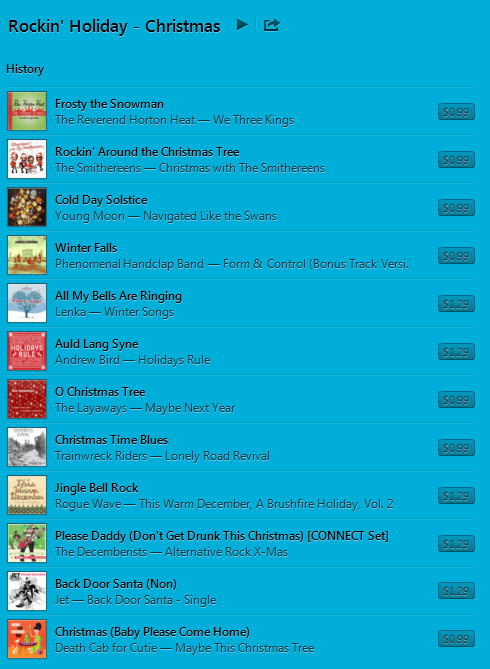
It seems very likely that the large increase in sales of our song (relative to previous years) was a direct result of the iTunes Radio spins it received. The big question, of course, is does this single anecdotal example represent an overall trend -- is iTunes Radio increasing the sales of music downloads?
It seems intuitive that ease of purchase -- you're already in iTunes and you can click to buy right there, as opposed to being directed from another website or interface to iTunes or Amazon MP3 -- might boost sales. Yet that doesn't appear to be the case. As Glenn Peoples reported in Billboard last year, the introduction of iTunes Radio did nothing to halt a year-long trend of declining download sales in 2013.
In our case, iTunes Radio was a net positive, because more than 100,000 listeners heard a song they probably wouldn't have otherwise known about, and a small percentage of those listeners purchased the track. But as noted in Billboard, a recent study by Music Forecasting makes the case that listeners are using iTunes Radio for a "lean-back" passive listening experience, one that is unlikely to result in large increases in music purchases. (The full PDF of the report is here.)
In addition to the download sales, we also received a payout from Apple for each spin of the song. As reported last year by the Future of Music Coalition and Digital Music News, Apple opted to make a direct payment to artists/labels for digital performance royalties instead of taking the compulsory path and making payments to SoundExchange.
For 103,874 spins of "O Christmas Tree" on iTunes Radio, we received $114.99 (before the deduction for CD Baby's commission). That translates to a little more than 0.11 cents per play. That's slightly less than the "$0.0013 per song plus 15% of net advertising revenue for the first year" spelled out by Apple's contract with indie labels, though I'm uncertain if that rate also includes payments Apple makes to music publishers. After I receive my BMI statement for the quarter, I can calculate the total payment we received for each iTunes Radio play.
Labels: Apple, holiday music, iTunes Radio, music sales
link 0 comments e-mail listen to the Layaways on SpotifyFollow @digitalaudio Tweet
June 07, 2012
Match Game 2012: First Artist Payments from iTunes Matchby David Harrell
Compensation for labels and musicians for music sales from Apple's iTunes store is straightforward: Apple takes a 30% cut and passes the remaining 70% to the label or digital distributer. For Apple's iTunes Match service, compensation is a little more complicated. There's the same 70/30 split, as Apple shares 70% of the $24.99 annual subscription fee, but the per-track payout is variable, as explained in the FAQs of digital distributor CD Baby:
iTunes will issue payment for every play that takes place through iTunes Match. The per-play rate varies based on subscription revenue, exchange rates, and total number of plays. Pay rates should look similar to streaming services such as Spotify.Over the past week, our first iTunes Match payouts showed up in our CD Baby account. For November 2011, we received .012767 cents per play (before CD Baby's 9% commission). For December 2011, we received considerably more: .12083 cents per play, before commission. That positive trend continued with per-play payments of .20231 cents for January 2012 and .25946 cents for February. UPDATE 6/8/2012: The above numbers are all for "iTunes Match - Americas." Some payments for iTunes Match - UK were just added to our CD Baby account. For February 2012, we received .13723 cents per play.
The best explanation I can think of for the increasing payout amounts is that iTunes Match keeps adding new subscribers who are making minimal use of the service to stream their tracks using different devices. That is, if an individual iTunes Match subscriber only listens to music on the device where her music was originally stored, no income is generated for labels and artists, thereby increasing the payout rate for tracks played by other subscribers.
As for the Spotify comparison, keep in mind that Spotify rates also vary, based on the subscriber's plan (free or one of two premium options), prices for different regions, and exchange rates. Last year, I posted that we had received per-play payouts ranging from a low of .02056 cents to a high of 1.1456 cents, with an average of .2865 cents. Since then, our average Spotify payment has increased to .41792 cents per play, so the current trend will have to continue for iTunes Match payouts to approach the average Spotify rate.
In theory, however, payouts from iTunes Match are a truly supplemental income stream, as unlike Spotify, there isn't the possibility of cannibalizing music sales with lower-paying streams. If iTunes Match becomes a popular service, it will provide some sort of an additional income stream to large labels, though how much of that revenue will make its way to the biggest artists is another question, as it is with the payouts from Spotify and other streaming services. But for smaller acts and labels, it's less likely that iTunes Match will be a significant source of new income.
Labels: Apple, iTunes, iTunes Match, Spotify
link 3 comments e-mail listen to the Layaways on SpotifyFollow @digitalaudio Tweet
October 06, 2011
Steve Jobs in 1981by David Harrell
Via Google books: Except for the product names and dates, the quotes in this 1981 New Scientist piece on Steve Jobs sound remarkably recent:

Labels: 1980s, 1981, Apple, Steve Jobs
link 0 comments e-mail listen to the Layaways on SpotifyFollow @digitalaudio Tweet
October 04, 2011
The Flaw in the Standard Apple vs. Amazon Digital Pricing Storyby David Harrell
Amazon's price for the upcoming Kindle Fire ($199) conforms to the storyline that has emerged over the last year or so about the respective digital pricing strategies of Amazon and Apple. That is, Apple's happy to break even on digital content sales because its iPods, iPhones, and iPads are so profitable, while Amazon prices its hardware aggressively to encourage the sales of profitable digital content.
But there's a slight problem with this narrative: digital content is often cheaper at Amazon. For example, as of this afternoon, the top 10 tracks in the iTunes store are selling for $1.29 each, while eight of those songs are available for just 99 cents each at Amazon MP3. You'll find a similar trend for digital albums -- most of the top 10 sellers are less expensive at Amazon MP3. (Due to the switch to the "agency model," prices for the best-selling digital books are usually the same in both stores.)
Unless Amazon is losing money on all of this digital content in order to build its market share (that's clearly happening in certain cases), the digital content sold by Apple is probably more profitable than generally assumed. (Way back in 2008, Saul Hansell suggested that Apple was sandbagging when it discussed the profitability of iTunes sales.) If so, it means Apple has been able to exact a premium price for both its hardware devices and the digital content that fills them.
Update: After I posted a link to this story on Google+, my friend Aaron made a comment about the role of content providers in setting prices, something I probably should've addressed in the original post. As far as I know, Apple and Amazon pay the same wholesale prices to labels and digital distributors. Yet Amazon is consistently using a smaller markup for its retail prices. While the premium Apple commands for its hardware is easy to explain (design, usability, brand appeal, etc.), the willingness for consumers to pay higher prices to Apple for identical digital content is harder to understand. I suppose it comes down to the convenience of the single system, even though music purchased from Amazon will download directly to your iTunes library!
Labels: Amazon, Apple, digital music pricing
link 0 comments e-mail listen to the Layaways on SpotifyFollow @digitalaudio Tweet
August 26, 2011
Friday Flashback Fun: 1983 Apple Commercialby David Harrell
I don't have anything profound to say about Wednesday's news about Steve Jobs, but it somehow reminded me of something I posted a few years back -- this 1983 Apple commercial, where Kevin Costner bikes to the office on the weekend (with the family dog) to work all on night on his Apple computer:
Labels: 1980s, 1983, Apple, Kevin Costner
link 0 comments e-mail listen to the Layaways on SpotifyFollow @digitalaudio Tweet
June 17, 2010
C'est Lala Vieby David Harrell
It's been two and a half weeks since Apple shuttered Lala.com and it's not an exaggeration to say that I miss the site every day. The "hear any song once for free" model was just about perfect. I'd stream albums while reading music reviews at Pitchfork, listen to tracks before deciding how to spend my monthly allotment of eMusic downloads, and it was always the first place I'd go to listen to a new (or old) album that I read about it. There are, of course, other options for streaming music online, but everything I tried in the past was inferior to the Lala experience. I had no luck with my Napster subscription (just couldn't get the music player to work on my PC), though I suppose I should try a Rhapsody or MOG subscription.
The question now is how much of Lala's functionality will Apple incorporate into iTunes. While much of the recent speculation has been about the cloud/digital locker feature, a digital locker functionality seems unlikely. Unless Apple follows the Google approach of pulling data from users' hard drives, the major label groups are likely to balk at cloud-based iTunes libraries. (See EMI's long-term harassment of Michael Robertson over digital lockers.) But what I'd most like to see in iTunes is some sort of music streaming capability, if only the "one-time free stream" option that Lala provided.
Historically, the economics have been challenging for streaming services. For paid subscription services, which can offer reasonable compensation (around one cent) to labels for each stream, the difficulty has been growing their subscriber bases. While millions of U.S. households are willing to pay for $30 or more each month for cable/satellite service, only a tiny percentage of the country appears to be willing to spend a smaller amount for music access. And the problem with free, ad-supported streams is that ad rates simply aren't high enough to allow the streaming services to offer reasonable payments to labels for each stream, let alone generate enough profit to support and grow the company. (See this recent post on Spotify payouts.)
Apple, however, should it choose to offer some sort of free streams via iTunes, has one major advantage over any other streaming music provider: It doesn't have to make money from it. Apple has famously claimed that it essentially breaks even on music sales from the iTunes store. Yet given how many high-margin iPods and iPhones Apples sells, it could even stand to lose money on iTunes music sales, provided that they encourage the purchase of Apple hardware. Ditto for free streams.
The numbers here are a little different, of course, as a one cent or 1/2 cent payout per stream means each song played is a net negative for Apple. But if a Lala-style "stream any song once" option encouraged additional iTunes music sales or iPod purchases, it could make sense for Apple.
Thank you to my friend Jeff Kelley for the title post!
Labels: Apple, iTunes, Lala.com, music streaming
link 5 comments e-mail listen to the Layaways on SpotifyFollow @digitalaudio Tweet
April 30, 2010
Bye Bye Lalaby David Harrell
Apple will pull the plug on the Lala music streaming service on May 31st. From an e-mail sent this morning to Lala members:
The Lala service will be shut down on May 31st.link 0 comments e-mail listen to the Layaways on Spotify
In appreciation of your support over the last five years, you will receive a credit in the amount of your Lala web song purchases for use on Apple's iTunes Store. If you purchased and downloaded mp3 songs from Lala, those songs will continue to play as part of your local music library.
Remaining wallet balances and unredeemed gift cards will be converted to iTunes Store credit (or can be refunded upon request). Gift cards can be redeemed on Lala until May 31st.
Follow @digitalaudio Tweet
January 11, 2007
Gift Card Economicsby David Harrell
Over the holidays, I noticed that Target was selling $30 iTunes gift cards for $25, which would bring your single-song download price to less than 84 cents. But the discounted cards probably aren't a loss leader for Target -- Apple will discount song codes if you purchase at least 100,000 songs and I'm assuming it offers a similar price break gift cards for retailers.
I can't seem to find any public information on the actual discount amount, though Apple can only go so low before it loses money on the transaction, as it pays approximately 70 cents to labels/artists for each single song download. But that's assuming the gift cards are actually used in full, which often isn't the case. According to this NY Times piece by Stephen Dubner and Steven Levitt, there's a breakage rate -- on average -- of at least 10%:
As for gift cards -- well, let's just say there is good reason that they are known within the retail industry as a stored-value product: they store their value very well, and often permanently. The financial-services research firm TowerGroup estimates that of the $80 billion spent on gift cards in 2006, roughly $8 billion will never be redeemed -- "a bigger impact on consumers," Tower notes, "than the combined total of both debit- and credit-card fraud." A survey by Marketing Workshop Inc. found that only 30 percent of recipients use a gift card within a month of receiving it, while Consumer Reports estimates that 19 percent of the people who received a gift card in 2005 never used it.So even if Apple offers a large discount to retailers on gift cards, it might come out ahead on the average download "price." As noted in this post from last year, Napster has begun to realize the revenue from such digital breakage.
Labels: Apple, digital breakage, gift card economics, gift cards, iTunes
link 0 comments e-mail listen to the Layaways on SpotifyFollow @digitalaudio Tweet
September 22, 2006
Friday Flashback Fun: Kevin Costner Apple Adby David Harrell
What was Kevin Costner doing back in 1983? Biking to the office on the weekend (with the family dog), and working all night on an Apple computer:
Labels: 1980s, 1983, Apple, Friday Flashback Fun, Kevin Costner
link 0 comments e-mail listen to the Layaways on SpotifyFollow @digitalaudio Tweet
September 15, 2006
Friday Flashback Fun: 1983 Apple Presentationby David Harrell
No, not the one earlier this week. It's 1983 and an unbelievably smug-looking Steve Jobs describes the coming battle between Apple and the evil IBM:
Labels: 1980s, 1983, Apple, Friday Flashback Fun, IBM
link 0 comments e-mail listen to the Layaways on SpotifyFollow @digitalaudio Tweet
January 09, 2006
Why Music Subscriptions Are Like Health Clubsby David Harrell
You've probably heard of the "health club business model." The idea is to sign up as many people as possible for a service that most are unlikely to fully use. A health club would be overrun if all of its members exercised regularly, but since most of us have better intentions than discipline for exercise, gym attendance drops dramatically as New Year's resolutions are broken. And if you never get around to canceling that membership, the result is a "free" income stream for the health club. Gym rats get their money's worth from their memberships, the rest of us are paying for something that we don't use.
Of course, if you think about it, this principle applies to pretty much any business that offers an unlimited commodity or service for a fixed price: Lose money on a few customers and make it back (and more) with the rest. An all-you-can-eat restaurant can tolerate a few gluttons because of most of the dining crowd isn't so ravenous. Similarly, a healthy majority subsidizes the seriously ill within a health insurance plan.
With online music subscriptions, there's no worry that subscribers will overrun a physical location (for the sake of argument let's assume that server capacity is unlimited) and "running out" of downloads obviously isn't an issue. But there is an unavoidable limiting factor -- the fees the service must pay record companies and distributors for each song downloaded or streamed. Here are the details for Rhapsody Unlimited and eMusic, based on the actual per-song payouts that I've seen:
Rhapsody Unlimited allows subscribers unlimited listening to all of the tracks in its catalog for $9.99 a month. From that subscription fee, record companies and distributors are paid one cent for every song streamed. While $9.99 would cover 999 songs a month (ignoring all other business expenses for Rhapsody), a subscriber can easily exceed that number. Assuming an average song length of 4 minutes, you can listen to 15 songs in an hour. It'd take a whopping 67 hours of listening time each month to hear 999 tracks, but that averages out to just over two hours and 15 minutes a day. Factoring in other costs (servers, salaries, marketing, etc.), any customer who regularly listens for an hour or two daily is probably a net loss for Rhapsody.
With eMusic, it's all downloads, not streams. There are three subscription plans, starting at $9.99 a month. Technically, eMusic has a revenue sharing model where a percentage of its subscription revenue paid back to the record companies and distributors. But the revenue share dollars are translated into a per-track royalty each month when paying the record companies. (I'm assuming the revenue sharing amount is simply divided by the total number of downloads for the month.) Due to reporting lag, I only have data for one month of our sales via eMusic. For May 2005, it was 24 cents a track.
Because "royalties" are a fixed percentage of revenue for eMusic, it doesn't really matter how many tracks subscribers download each month. But it is interesting to see that how the royalty-per-track paid for a specific month compares to the subscription prices:
eMusic royalty costs per subscriber, May 2005
| Subscription Plan | Downloads per Month | Maximum payout to record companies |
| $9.99 | 40 | $9.60 |
| $14.99 | 65 | $15.60 |
| $19.99 | 90 | $21.60 |
In this interview, CEO David Pakman says that eMusic subscribers are currently averaging 31 downloads a month. Using the 24-cent-per-track royalty rate from May, that would translate into a revenue sharing amount in excess of 70% of the base subscription price. Given other expenses -- including what appear to be massive customer acquisition costs as eMusic pays its web affiliates a $6 bounty for every new trial user they deliver -- it seems likely that eMusic's current profit margin is razor thin, at best.
I'm wondering if such numbers are the reason behind Apple/Steve Jobs's reluctance to offer a music subscription service. From what I've read, Apple doesn't make much (if any) money on the downloads sold at iTunes, though the service does help Apple sell gazillions of very profitable iPods. But given the devotion of iPod/iTunes customers, maybe Jobs figures they're all a bunch of gym rats that would stream tracks all day with an iTunes subscription service, putting a major dent in Apple's bottom line.
(Note: some changes were made to the eMusic section on 1/17/2006, after I confirmed that eMusic did in fact have a revenue sharing model. Which means that the health club comparison really doesn't hold for eMusic, though I'm still amazed about the percentage of its subscription revenues that eMusic pays to the record companies.)
Labels: Apple, eMusic, health club model, music subscriptions, Rhapsody
link 1 comments e-mail listen to the Layaways on SpotifyFollow @digitalaudio Tweet
More Digital Audio Insider: Older Posts
Subscribe:
 RSS Feed
Add this blog to Del.icio.us, Digg, or Furl. Follow David Harrell on Google+.
The Digital Audio Insider Twitter feed:
Digital music jobs: Looking to hire? Looking for a job? Check out the digital audio insider job board.
Popular Posts
A Long Tail Experiment
By the Numbers: Using Last.fm Statistics to Quantify Audience Devotion
Lala.com Owes Me Sixty Cents
An Interview with Jonathan Segel of Camper Van Beethoven
Price Elasticity of Demand for McCartney
Sony and eMusic: What I Missed
The Digital Pricing Conundrum series:
Part One Part Two Part Three Part Four
THE LAYAWAYS
Out Now -- "Maybe Next Year" -- The New Holiday Album:
"This is a sweet treat, deliciously musical without being overbaked for mass media consumption." -- Hyperbolium
"Perfect listening to accompany whatever holiday preparations you may be making today." -- Bag of Songs
O Christmas Tree - free mp3 lyrics and song details
Away In A Manger - free mp3
Download from eMusic, iTunes, Amazon MP3, or Bandcamp. Listen to free streams at Last.fm.

"...about as melodic and hooky as indie pop can get." -- Absolute Powerpop
"Their laid-back, '60s era sounds are absolutely delightening." -- 3hive
"...melodic, garage-influenced shoegaze." -- RCRD LBL
Where The Conversation Ends - free mp3
January - free mp3
Keep It To Yourself - free mp3
Download from eMusic, iTunes, Amazon MP3, or CD Baby, stream it at Last.fm or Napster.

"The Layaways make fine indie pop. Hushed vocals interweave with understated buzzing guitars. The whole LP is a revelation from the start." -- Lost Music
"Catchy Guided by Voices-like rockers who lay it on sweetly and sincerely, just like Lionel Richie." -- WRUV Radio
Silence - free mp3 lyrics and song details
The Long Night - free mp3
Download from eMusic, Amazon MP3, or iTunes, stream it at Last.fm, Napster, or Rhapsody.

"These are songs that you want to take home with you, curl up with, hold them close -- and pray that they are still with you when you wake up." -- The Big Takeover
Let Me In - free mp3
Ocean Blue - free mp3
Download from eMusic, Amazon MP3, or iTunes, stream it at Last.fm, Napster, or Rhapsody.
More Layaways downloads:


the layaways website