
home
about/contact
Digital Audio Insider is David Harrell's blog about the economics of music and other digital content. I write from the perspective of a musican who has self-released four albums with the indie rock band the Layaways.
My personal website has links to my LinkedIn and Google+ pages and you can send e-mail to david [at] thelayaways [dot] com.
As an Amazon Associate I earn from qualifying purchases.
Support
If you enjoy this site, please consider downloading a Layaways track or album from iTunes, Amazon MP3, Bandcamp, or eMusic. CDs are available from CD Baby and Amazon.
links
music/media/tech:
Analog Industries
Ars Technica
AppleInsider
Brad Sucks Blog
Broken Record
Digital Music News
Duke Listens
Future of Music Coalition Blog
Hypebot
LA Times Technology Blog
The ListeNerd
Medialoper
Mediashift
MP3 Insider
Music Ally
Music Machinery
Music Think Tank
MusicTank
The Music Void
New Music Strategies
Online Fandom
Pakman's Blog
RAIN
Rough Type
RoughlyDrafted
Swindleeeee
TuneTuzer
Virtual Economics
economics/markets:
The Big Picture
Core Economics
Freakonomics
The Long Tail
Marginal Revolution
The Undercover Economist
mp3/music:
17 Dots
3hive
Fingertips
Shake Your Fist
Sounds Like the 80s
Unleash the Love
archives
January 2006
February 2006
March 2006
April 2006
May 2006
June 2006
July 2006
August 2006
September 2006
October 2006
November 2006
December 2006
January 2007
February 2007
March 2007
April 2007
May 2007
June 2007
July 2007
August 2007
September 2007
October 2007
November 2007
December 2007
January 2008
February 2008
March 2008
April 2008
May 2008
June 2008
July 2008
August 2008
September 2008
October 2008
November 2008
December 2008
January 2009
February 2009
March 2009
April 2009
May 2009
June 2009
July 2009
August 2009
September 2009
October 2009
November 2009
December 2009
January 2010
February 2010
March 2010
April 2010
May 2010
June 2010
July 2010
September 2010
October 2010
November 2010
December 2010
January 2011
February 2011
March 2011
April 2011
May 2011
June 2011
July 2011
August 2011
September 2011
October 2011
November 2011
December 2011
January 2012
February 2012
April 2012
May 2012
June 2012
August 2012
October 2012
November 2012
December 2012
January 2013
February 2013
March 2013
June 2013
August 2013
February 2014
March 2014
September 2014
December 2014
March 2015
October 2015
November 2015
December 2015
October 2016
May 2017
May 2025
January 30, 2013
A Few Quick Thoughts on the NY Times Spotify Articleby David Harrell

I know I've promised a long-form post on Spotify, but in the meantime, some quick observations on this week's NY Times article on the economics of music streaming:
1. Mainstream press -- please don't conflate streaming services with personalized Internet radio ("...as listeners begin to move from CDs and downloads to streaming services like Spotify, Pandora and YouTube."). Spotify and Pandora are cousins, not siblings.
2. With all due respect to Sean Parker, the glory days of music sales in 1990s aren't coming back. It was a unique time, when consumers were willing to repurchase music they already owned (on LP and cassette) in a more-expensive format (CD). Even if a magical new format is rolled out, one that makes average consumers want to upgrade, my guess is that many of them would manage to acquire the content without paying for it.
3. To its credit, the article does mention (but doesn't emphasize) what I think is the most important point about the Spotify model -- the coupling of artist/label compensation with listener consumption, as opposed to consumers pre-paying for a lifetime of listening via the purchase of a download or CD:
"Unlike the royalties from a sale, these payments accrue every time a listener clicks on a song, year after year."4. The per-play amounts paid to artists/labels are, as everyone knows, quite small. As noted in the article, self-released artist Zoe Keating reports an average payment of 0.42 cents per play. When you adjust that number for the 9% commission she pays to CD Baby, you end with 0.47 cents, which is almost identical to the most recent numbers I've posted here for Spotify plays of the Layaways.
Should Spotify pay more? In an ideal world it would, but the company is currently paying 70% of its revenue to rights holders and publishers. In addition to the freebie service, it offers two subscription tiers in the U.S. -- $4.99 a month for an ad-free service and $9.99 a month premium service with higher sound quality and a mobile option. Based on a 0.47 cents figure (and assuming that the current mix of free, $4.99, and $9.99 subscribers remained stable) Spotify would need to increase its U.S. subscription prices to $10.62 and $21.26 to accommodate a one cent per-play payout.
That larger number is still less than the $30 that Sam Broe, the 26-year-old music fan quoted at the beginning of the article, used to spend each month on music purchases before becoming a Spotify subscriber. But would he -- and other current/potential Spotify subscribers -- be willing to pay it?
Labels: music streaming, music subscriptions, Spotify
link 1 comments e-mail listen to the Layaways on SpotifyFollow @digitalaudio Tweet
August 28, 2012
Updated Spotify Artist/Label Per-Stream Paymentsby David Harrell
My 2011 post on Spotify payouts has received a ton of hits from a link in this NY Times piece on the royalties paid by Spotify and Pandora. So I thought it was time for some updated numbers, based on our most recent payouts from CD Baby.
For streams from August, 2009 to June, 2012, we've received an average per-stream payout of $.0046623 or .46623 cents, before CD Baby's 9% commission. The highest per-stream payout we've seen was $.011926 or 1.1926 cents and the lowest payout was $.0000237253 or .00237253 cents. (That's ignoring a handful of early "payouts" that rounded out to 0.0000000000 in CD Baby's accounting system!) My guess is that payout rates vary because of different Spotify plans (free and premium), differences in subscription prices for each region, and currency exchange rates.
Spotify Per-Stream PaymentsKeep in mind that these payouts are for self-released artists (or small labels) with digital distribution via CD Baby. The payout rates for the major label groups, which have an ownership stake in Spotify, may well be different.
August 2009 to June 2012
average: $.0046623
high: $.011926
low: $.0000237253
It's difficult to discern a general trend in the payout rates over time, though, in most cases, the lowest rates were in 2009 and early 2010. The all-time high rate of $.011926 was for streams in November, 2011 and our most-recent payouts, for June, 2012, were $.008246668 per stream.
Labels: music streaming, music subscriptions, Spotify
link 0 comments e-mail listen to the Layaways on SpotifyFollow @digitalaudio Tweet
November 11, 2011
Friday Flashback Fun: An Optimistic Outlook for Recorded Music, from 1888!by David Harrell
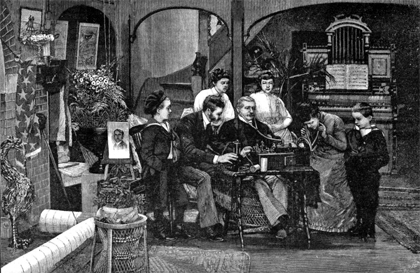
From what I've read, even though the first thing Thomas Edison ever recorded was his own performance of "Mary Had a Little Lamb," he originally envisioned audio recording for preserving dictation, not music. This 1888 article (PDF) is the earliest reference I could find in the Scientific American archive at Nature.com (which is free until the end of the month, hat tip to Alexis Madrigal) to the selling of recorded music:
Another new device perfects the method of duplicating phonograms containing matter which may be worth selling, such as books, music, sermons, speeches, or plays.Another interesting tidbit: The early plan was to rent, not sell, the playback devices:
In the United States, the Edison and Tainter patents on the phonograph have been purchased by the North American Phonograph Company, of New York, and the corporation expect to make of it the strongest sort of a monopoly. They have fixed the capital stock, as a starter, at the modest sum of $6,600,000, and will doubtless increase the amount, if the invention succeeds as well as they expect. The company proposes to follow the footsteps of the Bell Telephone Company in scooping in money. That is to say, the phonographs will be rented, not sold, the rental each year being say $40, or say five times more than the first cost of the instrument.
Labels: 1880s, 1888, Friday Flashback Fun, music subscriptions, Thomas Edison
link 2 comments e-mail listen to the Layaways on SpotifyFollow @digitalaudio Tweet
October 27, 2011
The Convergence of Owning Music and Renting Musicby David Harrell
 image by TheTruthAbout via Flickr
Earlier in the week, Hypebot pointed to this eMarketer summary of two recent studies about consumer attitudes about owning music vs. renting it:
The first of the two studies was a survey conduced by Insight Research Group on behalf of eMusic that revealed the widely noted insight that 91% of those polled preferred to own music rather than subscribing to it.There are real differences, both logistical and psychological, between owning and renting music. But I'll bet that the preference for ownership will decrease as the listening experience for "owned" and "rented" music converges. If you're using a website or app to listen to music on your computer or portable device, where the files are coming -- your hard drive, your cloud drive, or the server of a music subscription service -- doesn't have much effect on your listening experience. And a year from now, even more people will be using Spotify, iTunes Match, Amazon's Cloud Player, Google Music, and other services to listen to music. The more they do, the more willing they'll be to forgo actual ownership.
Music ownership isn't going away, as there are plenty of circumstances where a streaming service can't replicate what can be done with purchased music -- burning it to a disc, easily copying it, playing it without an Internet connection -- and, for the present, the sound quality of a CD is much higher than what's available from any streaming service. Yet for me, there's already plenty of music for which the ability to stream it suffices.
Labels: music streaming, music subscriptions
link 5 comments e-mail listen to the Layaways on SpotifyFollow @digitalaudio Tweet
July 15, 2011
A Very Quick Spotify Reviewby David Harrell
Spotify is now live in the U.S. While you can sign up today for one of two premium options ($4.99 or $9.99 a month), you'll still need an invite to try the free version. (Thanks to my friend Krista at Passport Delicious for hooking me up!)
My first impression is that Spotify is superior to the three other streaming music services -- MOG, Rhapsody, and Napster -- that I've tried, at least in terms of streaming performance. I'm a current subscriber to MOG, but I'm frustrated by the frequent pauses for buffering, even when using a fast connection. While it's been a while since I tried Napster, it was extremely buggy for me, with even more buffering/freezing problems. I had no such issues with Spotify during my brief test.
Unlike the other three services, which are all browser based, you'll need to download a small application (~5.0 mb) to use Spotify. The Spotify interface also allows you to play tracks stored on your hard drive in your iTunes and Windows Media libraries. One area that seems light in Spotify relative to the other services is editorial -- other than a display of new releases and lists for the top 100 tracks and albums, you're pretty much on your own for music discovery. MOG, for example, has tons of celebrity playlists, Billboard chart playlists, etc. There is a "Feed" section, however, which will list any Spotify music shared by your Facebook friends, and it seems safe to assume more editorial content will be added.
The free version of Spotify is supported by ads, which weren't overly intrusive in the half hour or so I spent listening -- I streamed at least five tracks before I heard the first one. Interestingly, I also heard an advertisement while listening to tracks from my iTunes library! I'm guessing these songs are played directly from my hard drive, and not streamed, so it's not like these plays incur a cost for Spotify. Maybe the ad algorithm doesn't yet distinguish the source of the song. More on Spotify next week!
Labels: music streaming, music subscriptions, Spotify
link 2 comments e-mail listen to the Layaways on SpotifyFollow @digitalaudio Tweet
July 07, 2011
Spot the Spotify Paymentby David Harrell
Please see this update for more recent Spotify payout numbers.
The U.S. launch of Spotify is imminent. And while I haven't had the same success as this musician (thanks to Glenn for the tip), two of my band's albums have been in the Spotify catalog since August of 2009.
Without any promotion in the regions where Spotify is currently available, our total number of plays is relatively small, though our Spotify activity seems to be increasing each month. The per-spin payouts we receive via CD Baby are quite variable, ranging from around two hundredths of cent to more than one cent for each stream. (We also had a few spins that rounded out to "$0.00000000" after CD Baby's commission.) I'm assuming the payout amount depends on free vs. premium listens, as well the subscription prices in each region and currency exchange rates.
Here's what we've seen so far:
Spotify Per-Stream Payouts August 2009 to March 2011These numbers are all before CD Baby's 9% commission. It's also possible that the major labels have been able to negotiate different rates for their content, and the label/artist payout doesn't include any payments for songwriters and publishers that Spotify makes to performance rights organizations such as BMI and ASCAP. Update II -- Spotify makes direct payments to PROs in Europe, but I think PRO payments are made by labels for music streaming in the U.S. More here. (This post from earlier in the year reports a per-stream rate of 0.22 Euro cents for independent artists.)
Smallest: 0.02056 cents
Largest: 1.1456 cents
Average: 0.2865 cents
Still, the average streaming rate is small enough that it'd take 244 Spotify spins to equal the label cut of a 99-cent iTunes download. But the real question here, in terms of artist/label compensation, is what Spotify activity actually represents. That is, is it simply a new revenue stream, providing income from listeners who don't normally purchase music, or is there also a cannibalization factor, where some listeners opt for streaming over actual purchase? (There's also the "exposure" argument that hearing something via Spotify or another streaming service will entice some listeners to purchase the download.) My best guess is that, given the relatively small percentage of consumers who regularly purchase music, any additional income streams are a net positive.
Please see this update for more recent Spotify payout numbers.
Labels: artist payments, music subscriptions, Spotify, streaming royalties
link 4 comments e-mail listen to the Layaways on SpotifyFollow @digitalaudio Tweet
January 10, 2006
Rhapsody, Streams, and Royaltiesby David Harrell
After posting yesterday's piece on music subscriptions and royalty fees, I came across this interview with Rob Glaser of Real Networks. According to Glaser, Rhapsody subscribers are, on average, listening to around 200 tracks a month. At that usage rate, Rhapsody's royalty expenses -- as a percentage of subscriber fees -- are much less than eMusic's.
However, with the $9.99 monthly subscription price, the average Rhapsody subscriber is spending close to five cents per stream. Which seems somewhat pricey compared to owning an mp3 for quarter from eMusic. And while I'm not sure people would pay a nickel for a la carte streams, when it's packaged as a subscription, they obviously don't seem to mind. I suppose it's a completely different mindset, as you've already made the subscription purchase decision (perhaps months ago) and you're probably not thinking in terms of cost per song.
Labels: music subscriptions, Rhapsody
link 0 comments e-mail listen to the Layaways on SpotifyFollow @digitalaudio Tweet
January 09, 2006
Why Music Subscriptions Are Like Health Clubsby David Harrell
You've probably heard of the "health club business model." The idea is to sign up as many people as possible for a service that most are unlikely to fully use. A health club would be overrun if all of its members exercised regularly, but since most of us have better intentions than discipline for exercise, gym attendance drops dramatically as New Year's resolutions are broken. And if you never get around to canceling that membership, the result is a "free" income stream for the health club. Gym rats get their money's worth from their memberships, the rest of us are paying for something that we don't use.
Of course, if you think about it, this principle applies to pretty much any business that offers an unlimited commodity or service for a fixed price: Lose money on a few customers and make it back (and more) with the rest. An all-you-can-eat restaurant can tolerate a few gluttons because of most of the dining crowd isn't so ravenous. Similarly, a healthy majority subsidizes the seriously ill within a health insurance plan.
With online music subscriptions, there's no worry that subscribers will overrun a physical location (for the sake of argument let's assume that server capacity is unlimited) and "running out" of downloads obviously isn't an issue. But there is an unavoidable limiting factor -- the fees the service must pay record companies and distributors for each song downloaded or streamed. Here are the details for Rhapsody Unlimited and eMusic, based on the actual per-song payouts that I've seen:
Rhapsody Unlimited allows subscribers unlimited listening to all of the tracks in its catalog for $9.99 a month. From that subscription fee, record companies and distributors are paid one cent for every song streamed. While $9.99 would cover 999 songs a month (ignoring all other business expenses for Rhapsody), a subscriber can easily exceed that number. Assuming an average song length of 4 minutes, you can listen to 15 songs in an hour. It'd take a whopping 67 hours of listening time each month to hear 999 tracks, but that averages out to just over two hours and 15 minutes a day. Factoring in other costs (servers, salaries, marketing, etc.), any customer who regularly listens for an hour or two daily is probably a net loss for Rhapsody.
With eMusic, it's all downloads, not streams. There are three subscription plans, starting at $9.99 a month. Technically, eMusic has a revenue sharing model where a percentage of its subscription revenue paid back to the record companies and distributors. But the revenue share dollars are translated into a per-track royalty each month when paying the record companies. (I'm assuming the revenue sharing amount is simply divided by the total number of downloads for the month.) Due to reporting lag, I only have data for one month of our sales via eMusic. For May 2005, it was 24 cents a track.
Because "royalties" are a fixed percentage of revenue for eMusic, it doesn't really matter how many tracks subscribers download each month. But it is interesting to see that how the royalty-per-track paid for a specific month compares to the subscription prices:
eMusic royalty costs per subscriber, May 2005
| Subscription Plan | Downloads per Month | Maximum payout to record companies |
| $9.99 | 40 | $9.60 |
| $14.99 | 65 | $15.60 |
| $19.99 | 90 | $21.60 |
In this interview, CEO David Pakman says that eMusic subscribers are currently averaging 31 downloads a month. Using the 24-cent-per-track royalty rate from May, that would translate into a revenue sharing amount in excess of 70% of the base subscription price. Given other expenses -- including what appear to be massive customer acquisition costs as eMusic pays its web affiliates a $6 bounty for every new trial user they deliver -- it seems likely that eMusic's current profit margin is razor thin, at best.
I'm wondering if such numbers are the reason behind Apple/Steve Jobs's reluctance to offer a music subscription service. From what I've read, Apple doesn't make much (if any) money on the downloads sold at iTunes, though the service does help Apple sell gazillions of very profitable iPods. But given the devotion of iPod/iTunes customers, maybe Jobs figures they're all a bunch of gym rats that would stream tracks all day with an iTunes subscription service, putting a major dent in Apple's bottom line.
(Note: some changes were made to the eMusic section on 1/17/2006, after I confirmed that eMusic did in fact have a revenue sharing model. Which means that the health club comparison really doesn't hold for eMusic, though I'm still amazed about the percentage of its subscription revenues that eMusic pays to the record companies.)
Labels: Apple, eMusic, health club model, music subscriptions, Rhapsody
link 1 comments e-mail listen to the Layaways on SpotifyFollow @digitalaudio Tweet
January 04, 2006
Download Rolloversby David Harrell
As a customer, my one small complaint about the eMusic model is the "use-it-or-lose-it" component of your subscription: If you don't use all of your monthly allotment of downloads, they expire. On the flipside, as discussed in my previous post, I think this feature actually benefits the artists distributed by eMusic by encouraging customers to take chances on unknown bands.
Some cell phone plans allow you to rollover your unused minutes each month and it seems like a similar feature would be great for eMusic subscribers. But that's extremely unlikely to happen. Here's why:
It'd be an absolute nightmare for eMusic. Accounting regulations require companies to recognize revenue and expenses at the same time. With subscriptions, even if the money is paid up front, a firm can't recognize that revenue until the product/service is delivered. (This is a simplified explanation based on some details about "deferred subscription liability" that my stock analyst colleague Joe B. kindly shared with me.) If a subscriber piles up hundreds of downloads by rolling over each month's download allotment, eMusic can't recognize the monthly subscription revenue. And, unlike providers of cell phone service, where the liability is primarily an internal expense, eMusic has huge external expenses associated with each download -- the money that must be paid to the record company or distributor for each song. (More on this in an upcoming post!) So don't hold your breath waiting for a rollover option for your subscription.
Labels: eMusic, music subscriptions
link 0 comments e-mail listen to the Layaways on SpotifyFollow @digitalaudio Tweet
More Digital Audio Insider: Older Posts
Subscribe:
 RSS Feed
Add this blog to Del.icio.us, Digg, or Furl. Follow David Harrell on Google+.
The Digital Audio Insider Twitter feed:
Digital music jobs: Looking to hire? Looking for a job? Check out the digital audio insider job board.
Popular Posts
A Long Tail Experiment
By the Numbers: Using Last.fm Statistics to Quantify Audience Devotion
Lala.com Owes Me Sixty Cents
An Interview with Jonathan Segel of Camper Van Beethoven
Price Elasticity of Demand for McCartney
Sony and eMusic: What I Missed
The Digital Pricing Conundrum series:
Part One Part Two Part Three Part Four
THE LAYAWAYS
Out Now -- "Maybe Next Year" -- The New Holiday Album:
"This is a sweet treat, deliciously musical without being overbaked for mass media consumption." -- Hyperbolium
"Perfect listening to accompany whatever holiday preparations you may be making today." -- Bag of Songs
O Christmas Tree - free mp3 lyrics and song details
Away In A Manger - free mp3
Download from eMusic, iTunes, Amazon MP3, or Bandcamp. Listen to free streams at Last.fm.

"...about as melodic and hooky as indie pop can get." -- Absolute Powerpop
"Their laid-back, '60s era sounds are absolutely delightening." -- 3hive
"...melodic, garage-influenced shoegaze." -- RCRD LBL
Where The Conversation Ends - free mp3
January - free mp3
Keep It To Yourself - free mp3
Download from eMusic, iTunes, Amazon MP3, or CD Baby, stream it at Last.fm or Napster.

"The Layaways make fine indie pop. Hushed vocals interweave with understated buzzing guitars. The whole LP is a revelation from the start." -- Lost Music
"Catchy Guided by Voices-like rockers who lay it on sweetly and sincerely, just like Lionel Richie." -- WRUV Radio
Silence - free mp3 lyrics and song details
The Long Night - free mp3
Download from eMusic, Amazon MP3, or iTunes, stream it at Last.fm, Napster, or Rhapsody.

"These are songs that you want to take home with you, curl up with, hold them close -- and pray that they are still with you when you wake up." -- The Big Takeover
Let Me In - free mp3
Ocean Blue - free mp3
Download from eMusic, Amazon MP3, or iTunes, stream it at Last.fm, Napster, or Rhapsody.
More Layaways downloads:


the layaways website