
home
about/contact
Digital Audio Insider is David Harrell's blog about the economics of music and other digital content. I write from the perspective of a musican who has self-released four albums with the indie rock band the Layaways.
My personal website has links to my LinkedIn and Google+ pages and you can send e-mail to david [at] thelayaways [dot] com.
As an Amazon Associate I earn from qualifying purchases.
Support
If you enjoy this site, please consider downloading a Layaways track or album from iTunes, Amazon MP3, Bandcamp, or eMusic. CDs are available from CD Baby and Amazon.
links
music/media/tech:
Analog Industries
Ars Technica
AppleInsider
Brad Sucks Blog
Broken Record
Digital Music News
Duke Listens
Future of Music Coalition Blog
Hypebot
LA Times Technology Blog
The ListeNerd
Medialoper
Mediashift
MP3 Insider
Music Ally
Music Machinery
Music Think Tank
MusicTank
The Music Void
New Music Strategies
Online Fandom
Pakman's Blog
RAIN
Rough Type
RoughlyDrafted
Swindleeeee
TuneTuzer
Virtual Economics
economics/markets:
The Big Picture
Core Economics
Freakonomics
The Long Tail
Marginal Revolution
The Undercover Economist
mp3/music:
17 Dots
3hive
Fingertips
Shake Your Fist
Sounds Like the 80s
Unleash the Love
archives
January 2006
February 2006
March 2006
April 2006
May 2006
June 2006
July 2006
August 2006
September 2006
October 2006
November 2006
December 2006
January 2007
February 2007
March 2007
April 2007
May 2007
June 2007
July 2007
August 2007
September 2007
October 2007
November 2007
December 2007
January 2008
February 2008
March 2008
April 2008
May 2008
June 2008
July 2008
August 2008
September 2008
October 2008
November 2008
December 2008
January 2009
February 2009
March 2009
April 2009
May 2009
June 2009
July 2009
August 2009
September 2009
October 2009
November 2009
December 2009
January 2010
February 2010
March 2010
April 2010
May 2010
June 2010
July 2010
September 2010
October 2010
November 2010
December 2010
January 2011
February 2011
March 2011
April 2011
May 2011
June 2011
July 2011
August 2011
September 2011
October 2011
November 2011
December 2011
January 2012
February 2012
April 2012
May 2012
June 2012
August 2012
October 2012
November 2012
December 2012
January 2013
February 2013
March 2013
June 2013
August 2013
February 2014
March 2014
September 2014
December 2014
March 2015
October 2015
November 2015
December 2015
October 2016
May 2017
May 2025
July 07, 2011
Spot the Spotify Paymentby David Harrell

Please see this update for more recent Spotify payout numbers.
The U.S. launch of Spotify is imminent. And while I haven't had the same success as this musician (thanks to Glenn for the tip), two of my band's albums have been in the Spotify catalog since August of 2009.
Without any promotion in the regions where Spotify is currently available, our total number of plays is relatively small, though our Spotify activity seems to be increasing each month. The per-spin payouts we receive via CD Baby are quite variable, ranging from around two hundredths of cent to more than one cent for each stream. (We also had a few spins that rounded out to "$0.00000000" after CD Baby's commission.) I'm assuming the payout amount depends on free vs. premium listens, as well the subscription prices in each region and currency exchange rates.
Here's what we've seen so far:
Spotify Per-Stream Payouts August 2009 to March 2011These numbers are all before CD Baby's 9% commission. It's also possible that the major labels have been able to negotiate different rates for their content, and the label/artist payout doesn't include any payments for songwriters and publishers that Spotify makes to performance rights organizations such as BMI and ASCAP. Update II -- Spotify makes direct payments to PROs in Europe, but I think PRO payments are made by labels for music streaming in the U.S. More here. (This post from earlier in the year reports a per-stream rate of 0.22 Euro cents for independent artists.)
Smallest: 0.02056 cents
Largest: 1.1456 cents
Average: 0.2865 cents
Still, the average streaming rate is small enough that it'd take 244 Spotify spins to equal the label cut of a 99-cent iTunes download. But the real question here, in terms of artist/label compensation, is what Spotify activity actually represents. That is, is it simply a new revenue stream, providing income from listeners who don't normally purchase music, or is there also a cannibalization factor, where some listeners opt for streaming over actual purchase? (There's also the "exposure" argument that hearing something via Spotify or another streaming service will entice some listeners to purchase the download.) My best guess is that, given the relatively small percentage of consumers who regularly purchase music, any additional income streams are a net positive.
Please see this update for more recent Spotify payout numbers.
Labels: artist payments, music subscriptions, Spotify, streaming royalties
link 4 comments e-mail listen to the Layaways on SpotifyFollow @digitalaudio Tweet
July 05, 2011
Tuesday Odds and Endsby David Harrell
Another free music debate -- when should musicians give away live music?
Tom Petty doesn't like Michele Bachmann using American Girl, but while using a track without permission in an ad is a definite no-no, playing recorded music at an assembly is apparently fine, as long as the venues/campaigns have paid for BMI/ASCAP licenses.
It's now illegal in Tennessee to share passwords for Rhapsody, Netflix, and other streaming services.
The decline of rock radio in Chicago:
"Over time, we've realized that this music is going to live forever; the radio stations, not necessarily."One thing that seems likely to live forever on Chicago radio is 70s-era Rolling Stones. I was channel surfing in the car on Sunday afternoon and heard a simultaneous Stones triple play on three classic rock stations: "Ain't Too Proud to Beg," "It's Only Rock 'n Roll," and "Shattered."
Finally, the last thing I want is another social networking page to maintain, but I'm intrigued by the "circles" feature in Google+. In theory, you can do the same thing on Facebook by creating friend lists, then posting certain items only for specific lists. But you'd have trust FB not to screw everything up with its next privacy overhaul, and its track record isn't so good in that area. (I've only seen the demo, no invite yet for the actual "Field Trial." So if any Google folks are reading...)
tags: digital music Google+ GOOG
link 0 comments e-mail listen to the Layaways on Spotify
Follow @digitalaudio Tweet
June 21, 2011
Some Details (and Questions) About Apple's iTunes Match Serviceby David Harrell
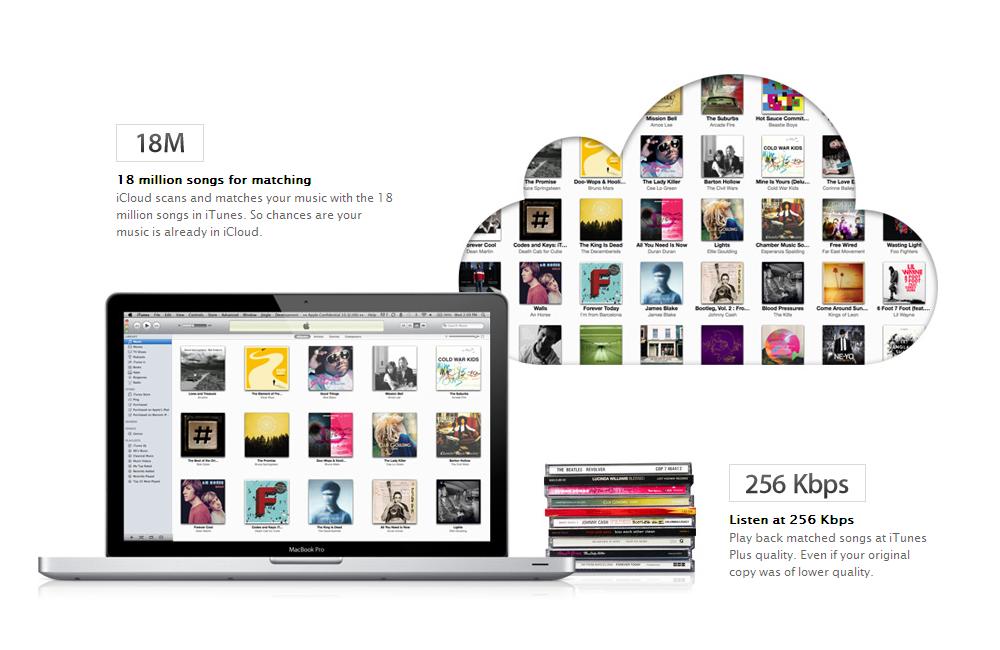
A Chicago label is getting some attention for opting out of Apple's iTunes Match service. Numero's Ken Shipley also shared some financial details about iTunes Match in a comment to a recent Hypebot post on Numero's decision. Based on that information, we can make some assumptions about how the service will work:
1. Apple Is Reaching Out to Indie Labels
We know that all four major label groups are on board with iTunes Match, but it appears that Apple is contacting at least some indie labels directly to convince them to include their catalogs in the matching service.
2. A Match Is Enough
I had wondered if payments to labels might be based on the number of times a track was played. But the way Shipley describes it, if a track is contained in an iTunes library, that constitutes a "match," and a payment to the label.
3. The Per-Track Payouts Are Small (and Variable)
This was a given, of course. At $24.99 a year, there's simply not a lot of cash to share with labels. Shipley gives a figure of .0035 cents per match for a 5,000 track library, of which .0006 cents would be shared with the publisher of the song. However, I'm wondering if he meant .35 cents instead of .0035. Apple will share 70% of the $24.99 annual subscription fee, or $17.50 with labels. If you multiply 5,000 by .35 cents, it equals $17.50. Assuming that the payout is the larger figure, it'd still require 200 matches to equal the 70 cents that Apple pays for a 99-cent iTunes download. Though if the payout is based on the size of an individual user's iTunes library, the per-track amount will vary. Apple says it will support libraries of up to 25,000 tracks. If you divide $17.50 by that number, the per-match rate would be .07 cents.
4. Avoiding the "S" and "D" Words
At this point, no one seems to know for certain if matched tracks will be streamed by Apple to a device or if a match simply allows a subscriber to download the track. I thought the language on Apple's site suggested streaming, though I've read that it's a download, as Apple is worried that streaming would result in a huge bandwidth/data problem if iPhone users streamed their music collections all day.
According to Shipley's comments, Apple is avoiding both the "streaming" and "downloading" words because they don't want to be liable for current streaming rates or mechanical royalties.
We'll learn more details over the summer, but for now, here are a couple of unanswered questions:
1. A One-Time or Annual Payment?
Will a label receive a payment every year, as long as the track remains in a user's iTunes library? Given that subscribers pay the $24.99 maintenance fee each year, it seems more likely that it's an ongoing payment.
2. Is a Match Based Solely on Metadata?
While Apple has been lauded for coming up with a model that results in a revenue stream for music that might have been obtained illegally, that's a negative in Shipley's view. Whatever the quality/bit rate of the file on your hard drive, iTunes Match will upgrade it to 256k AAC file. Yet if the match is based solely on a music file's metadata, you don't even have to obtain the actual track -- you could simply change a file's metadata in iTunes or another program. It'd be a pain, but that with a few clicks and a bit of typing you could match any track in the iTunes catalog.
If you work for a label and can confirm any of the above, or have other details you're willing to share, please leave a comment or shoot me an e-mail. Thanks!
related: Some Quick Thoughts On iTunes Match
tags: digital music iTunes iTunes Match Apple AAPL music subscriptions
link 1 comments e-mail listen to the Layaways on Spotify
Follow @digitalaudio Tweet
June 16, 2011
A Few Thoughts On Pandoraby David Harrell

Pandora has a lot going for it: It's the best-known name/brand in Internet radio and it has more than 90 million registered users, with 30 millions "active" users. Yet as noted in this WSJ piece, the newly-public company has yet to turn a profit. Like all Internet radio stations, it pays out a very large percentage of its revenue to music publishers and labels.
Also, unlike competitors such as Last.fm, Pandora has an additional expense, that associated with building and maintaining the "Music Genome Project," which classifies individual songs based on up to 450 criteria. A song's "DNA," as determined by Pandora's team of musicians and musicologists, along with listener feedback, is used to program individual Pandora stations.
So here's the big question: Does Pandora's Music Genome-based programming give it a competitive advantage? That is, does it result in a better listener experience than with Internet stations like Last.fm, where "similar" artists are determined by listener overlap (listeners of artist A also like artist B), as opposed to song qualities?
For me, the answer is a definite "no." I've tried Pandora multiple times and have never been impressed with the playlists. One example: when I played a U2 station, the next three artists it served up were Pearl Jam, Coldplay, and...the Goo Goo Dolls?! Coldplay makes some sense, but someone is going to have to explain to me how the music DNA of U2 suggests that the Goo Goo Dolls are one of the three most similar artists. (It's also apparent that, in addition to song DNA, Pandora uses a popularity component in its programming algorithm. If I create a station for my own band, it primarily serves up equally obscure artists. To be fair, I could easily hear why most of these artists were considered similar, based on the songwriting and arrangements. And I can completely understand the reason for including a popularity component -- while I'm open minded when it comes to music, you don't necessarily want to listen exclusively to acts you've never heard of before!)
I'm not saying the Pandora listener experience is a bad one, I just haven't found it superior to Last.fm or Slacker. The size of the company's user base and the business relationships it has established (deals with many car manufacturers) might well give it an ongoing advantage over its competitors. But in my opinion, music programming isn't a major differentiator for Pandora.
related: Prospectus for Pandora, Pandora's Seventy Percent, Some Quick Thoughts on the Quirk Presentation
tags: digital music Pandora P Internet radio
link 3 comments e-mail listen to the Layaways on Spotify
Follow @digitalaudio Tweet
June 07, 2011
Some Quick Thoughts On iTunes Matchby David Harrell
My question from last week was answered -- by matching any song on a hard drive that's available in the iTunes store, iTunes Match is a game changer. Assuming that Google and Amazon don't add a similar feature, Apple's service will launch with a major advantage over its competitors. However, as Amazon was quick to Tweet yesterday, it appears that iTunes Match won't allow you to download tracks, only stream them. Update: I might be wrong about downloading vs. streaming. I've read several reports that indicate that the iTunes Match/iCloud service will only allow downloading of files to devices, as opposed to true streaming. (And I haven't used the beta version of iTunes in the Cloud yet.) If so, it seems somewhat illogical, as the big advantage of scanning and matching is that it eliminates the need to upload digital music files. To then turn around and require a download to listen to them makes little sense to me. The Apple site is vague, though "all the music iTunes matches plays back at 256-Kbps iTunes Plus quality" seems to imply streaming.
Will iTunes Match legitimize/monetize pirated digital music files? At the very least, it introduces a new revenue stream for labels that didn't exist before, allowing them to reap additional revenue for purchased digital tracks, as well as songs ripped from CDs, downloaded as free legal mp3s, or acquired via P2P sharing. How much revenue? The service will cost users $24.99 a year and Apple will share 70% of that amount, $17.50, with labels and publishers. As of late 2010, Apple claimed 160 million iTunes users worldwide. If 10% of those users signed up for iTunes Match, that'd translate into $280 million a year for labels and publishers. That's a lot of money, but it doesn't begin to offset the declines in recorded music sales over the past decade. (Maybe Apple will be able to convert more than 10% of its iTunes user base. Netflix, for example, has 20 million subscribers who are paying substantially more for that service.)
How will Apple divide that money and pay it out? It could be based on an individual user's streaming activity, where either a set amount is paid for each song stream or a variable per-stream amount, based on the total number of streams during the month. That is, if a user only streamed one song in a month, the label and publisher for that release would receive the full amount. But it seems like any user-based accounting system would be a bookkeeping nightmare for Apple. My guess is that the subscription fees will be divvied up based on total subscriber behavior, with label and publishers receiving a portion of the iTunes Match subscription fee proportionate to the total activity of each track.
One final thought: Steve Jobs has long pooh-poohed the idea of music subscriptions, but maybe Apple is taking some baby steps toward a full-blown subscription service. As described, iTunes Match is essentially a music streaming service that's limited to a maximum of 25,000 tracks stored your iTunes library. At some point, it'd seem logical to allow users to stream the full iTunes catalog (18 million songs) for an additional fee.
related: Apple's iCloud Will Scan, But How Much Will It Match?
tags: digital music iTunes iTunes Match Apple AAPL music subscriptions
link 2 comments e-mail listen to the Layaways on Spotify
Follow @digitalaudio Tweet
June 02, 2011
Apple's iCloud Will Scan, But How Much Will It Match?by David Harrell
 image by José Picardo via Flickr
The news that Apple's iCloud will launch with a "scan and match" feature suggests that the service has a major advantage over the offerings from Amazon and Google, both of which requires users to upload their digital music files to the cloud. The size of that advantage, however, remains to be determined: Will the deals Apple reached with the four major label groups allow it to give users access to online versions of all of the music files on their hard drives, or just the digital tracks purchased from the iTunes store and other digital music retailers? If it's the former, it'd be an advantage that would pretty much force Amazon and Google to reach similar deals with the label groups. If the latter, the Apple edge would be considerably smaller, as purchased tracks represent a small portion of most digital music collections.
I have to think the issue was a sticking point in Apple's negotiations with the labels. While it's likely that the majority of the digital tracks in most music collections were ripped from their owners' CDs (that's the case for mine, at least), I'm sure the position of the labels was that they didn't want Apple giving consumers access to music tracks acquired from P2P networks. We'll find out next week what kind of agreement Apple was able to reach...
tags: digital music iCloud Apple AAPL iTunes Amazon AMZN Google GOOG
link 2 comments e-mail listen to the Layaways on Spotify
Follow @digitalaudio Tweet
June 01, 2011
Amazon MP3's $3.2 Million Customer Acquisition Experimentby David Harrell

Apple's seamless integration of software, hardware, and content (iTunes and the iTunes store, iPods and iPhones, and iTunes downloads) is often cited as the reason for its continued dominance of the digital music market. Yet this advantage is more one of perception that reality -- you can easily configure your settings with Amazon MP3 and eMusic to have downloads automatically appear in your iTunes library. I'd even argue that purchase process with Amazon MP3 is faster and more streamlined than with iTunes.
But a large percentage of digital music purchasers probably don't realize that Amazon MP3 and other digital retailers are viable alternatives to the iTunes store. (Some might not even know that you can play content purchased elsewhere in iTunes and on iPods!) Last week's 99-cent special for the new Lady Gaga album was an obvious attempt to reach those consumers.
Amazon MP3 moved approximately 440,000 digital albums at that loss leader price, which, according to Billboard's Glenn Peoples, cost Amazon about $3.2 million, as it paid the full wholesale price on each of those albums to Interscope/Universal Music Group. The question is, how many of those purchasers were first-time Amazon MP3 customers? After you've made your first purchase, any subsequent purchases are much easier, as you've already created and configured your account. Assuming that enough of last week's sales were to first time customers, I predict we'll see several more 99-cent album deals over the summer for other big-name releases.
tags: digital music Amazon MP3 AMZN Apple AAPL iTunes
link 2 comments e-mail listen to the Layaways on Spotify
Follow @digitalaudio Tweet
May 19, 2011
A Flat Fee or Commissions for Digital Music Distribution is an Economic Decision, Not a Moral Dilemma: TuneCore vs. CD Babyby David Harrell
I've been meaning to post a detailed CD Baby vs. TuneCore comparison for several years now and thought that last week's changes at TuneCore (a bunch of new features, accompanied by a hefty price increase for the annual maintenance fee) would motivate me to start writing. But what finally got me going was TuneCore C.E.O. Jeff Price's comments about the ethics of charging commissions. His desire to defend his company and its business model is understandable, but I don't think we need to frame the flat fee vs. commissions question as a moral argument.
Overlapping, Not Identical
As a self-released musician, I've used both CD Baby and TuneCore for distributing my music and -- for the most part -- I'm very satisfied with both services. I realized long ago that the best way to make money in the music industry is to sell stuff to aspiring musicians, many of whom will spend every cent they make from gigs, music sales, and their day jobs to support their dreams of a music career. In a world of scammers and rip-offs, both CD Baby and TuneCore provide a valuable service -- instant worldwide distribution for virtually any musician, something that was unthinkable 15 years ago. Both do so for reasonable fees and both firms have good reputations.
A direct comparison of the two companies is difficult, as their distribution services overlap somewhat, but they're certainly not identical. CD Baby began as online seller of physical CDs and later expanded to digital distribution, TuneCore was a digital distributor from the get-go. With TuneCore's recent enhancements, it currently provides more features on the digital end, while CD Baby will sell your CD through its online store and, via a deal with Super D distribution, allows people to order your CD from almost any record store.
The business models differ as well: CD Baby charges a one-time set-up fee and a 9% commission on digital sales, TuneCore doesn't charge commissions on digital sales but you'll pay an annual maintenance fee in addition to the initial set-up charge. Please note: I'm limiting this post to a discussion of CD Baby and TuneCore, the two services I've actually used. There are other alternatives, of course, but that's for a later post!
Running the Numbers
With the caveat that the services aren't identical, let's assume that digital distribution itself is basically a commodity service. That is, once your music is available within the catalogs of iTunes, Amazon MP3, eMusic, and other digital retailers and subscription services, there's no real difference between the distribution providers. If you don't need/want the extra bells and whistles that TuneCore provides, nor CD Baby's distribution of physical CDs, it simply comes down to how much you end up paying for digital distribution. (That's assuming, of course, that you trust the distributor to make timely, accurate royalty payments and to stay in business. I have no worries with either CD Baby or TuneCore.)
For the first year, no math is necessary -- because the initial set-up charges are virtually identical, you'll come out ahead with TuneCore. While CD Baby's album set-up fee is just $39, that amount doesn't include a UPC bar code. CD Baby charges $20 for a bar code, but you can easily purchase one on your own for $10, giving you a total cost of $49, which basically matches the $49.99 initial fee with TuneCore. No matter what your total digital sales are for the first year of a release, you'll pocket more with TuneCore, as you'll pay no commission on those sales.
After the first year, you have to determine if 9% of your ongoing annual royalties from the digital sales of an individual album will exceed TuneCore's annual maintenance fee. (Keep in mind that the iTunes payout for a 99-cent download is 70 cents.) Before TuneCore's price change, the crossover point was $222 in digital royalties, which represents approximately $317 in total digital sales. That's about 320 99-cent individual song downloads, 32 $9.99 digital albums sales, or some combination of the two.
With TuneCore's new annual maintenance fee of $49.99, the crossover point jumps to $555.44 of digital royalties, or approximately $794 in total digital sales for the album. That translates into 802 99-cent downloads or 80 digital albums. If you don't sell that much for an individual release, you're better off paying the 9% CD Baby commission. In fairness to TuneCore, you can turn the math around to calculate how much extra you might end up paying with a commission model. For example, if you manage to sell 5,000 99-cent downloads each year, you'll generate $3,500 in digital royalties and pay $315 in commissions to CD Baby, more than six times the annual TuneCore maintenance fee. (TuneCore also claims that some of its clients were already spending $65 to $70 per release each after paying for additional services such as tracking reports, and that the new all-inclusive fee will actually represent a price decrease for these clients.)
But the real question here is which outcome is more likely for most self-released musicians -- a few hundred dollars in digital sales per album each year or a few thousand? You could make the argument that a serious musician with any sort of talent could/should move enough units to exceed the crossover points above. And in the wake of last week's news about the pricing changes at TuneCore, there were plenty of Twitter and message board posts along the lines of "if you can't sell $50 of downloads then you shouldn't be releasing music." Yet the sales threshold isn't $50 in music sales a year -- it's selling enough digital downloads, each and every year (in a world where CD sales still dominate), to justify an ongoing annual maintenance fee instead of a small commission on each sale.
I hate to say it, but for the vast majority of self-released musicians, that seems unlikely. In a post from three years ago, I highlighted the example of an indie rock band that released a strong album, one that got a great response from both college radio and the music press, including:
Pitchfork love -- an 8.0 out of 10And this wasn't a self-released/financed album -- it was backed by the promotional muscle (new media, retail, and radio) and tour support of a well-known indie label with solid distribution. Yet it sold just a little over 5,000 total units. That album was released in 2004 and I doubt it has sold enough digital copies in the subsequent years to make the TuneCore model more attractive than the commission approach.
Strong support and airplay from KEXP -- one of the biggest/best known CMJ-reporting stations
Listed in "Top 10 Bands You Haven't Heard of" for the year by Rolling Stone magazine
Magnet Magazine's #3 record of the year
That's just one cherry-picked example, however, and you could just as easily point to dozens of TuneCore-distributed artists who would've paid significantly more for digital distribution under a commission-based model. Indeed, for the bigger-name acts featured on TuneCore's homepage -- acts like Cheap Trick, Joan Jett, Public Enemy, and Moby -- the decision to go with TuneCore was likely a no-brainer.
But new acts or those without established fan bases can't be sure they're going to sell. Here's what the founder of one well-respected indie label, spinART records, recently said about music sales:
I believed in every single of the 230+ releases and artists I signed and released. I did not think for a second that any of them would not sell. But the reality is, most did not take off, my label had the same hit to miss ratio as all other indie labels. Yes, we released successes like The Pixies, Apples In Stereo, The Dears and Clem Snide, but we also released The Technical Jed, Apollo Sunshine, Kaito, Head Of Femur and many others that, sadly, despite all of our marketing efforts, very few people bought.The label owner? TuneCore founder Jeff Price!
While you never know what's going to happen with any individual release, it appears that the typical self-released artist doesn't fare well under the TuneCore model. As recently calculated by Digital Music News, the average TuneCore client earns just $179 in digital royalties each year, and that's on a per-client basis, not $179 for each album. Any artist/small label earning this amount is obviously better off with the commission model, even before TuneCore's price increase.
However, if you get lucky and have a "hit" with a self-released album, you'll pay far more in commissions to CD Baby than you would with TuneCore's set annual fee. The worst-case scenario with the TuneCore model is that you'll pay more in annual fees than with a commission model, but you're only out fifty bucks a year at most. But if you sell tens of thousands of digital downloads with CD Baby, it will cost you thousands of dollars in commissions. Yet it's a risk that you can easily hedge against.
The Best of Both Worlds
CD Baby or TuneCore isn't necessarily an either/or question -- you can use both services together to maximize your income from digital sales in the first year and eliminate ongoing maintenance fees. If I were releasing a new album both on CD and as a digital download, touring to support it, and conducting a college radio campaign, I'd probably use TuneCore for digital distribution (at least for the first year) and CD Baby for online CD sales and inclusion in the Super D distribution catalog. After the first year or two, if the total digital sales of the album were below the crossover thresholds listed above, I'd ask TuneCore to pull the album from the digital stores and initiate digital distribution with CD Baby. (Because the album would already be in the CD Baby system, you wouldn't have to pay the $39 fee again.)
The downside to this approach is that you'd have a period of at least several weeks when the album wouldn't be available in digital stores, and you'd likely lose any customer ratings and reviews in each store. For that reason, I think RouteNote is an intriguing alternative -- it's a digital distributor that gives you the choice of a $30 annual maintenance fee or "free" distribution with a 15% commission on sales, and allows you to switch between the two pricing structures, based on your subsequent sales. I'd love to see CD Baby and TuneCore offer that kind of flexibility.
For now, I'm taking a wait-and-see approach with my TuneCore distributed album. Its annual sales don't justify paying a $49.99 maintenance fee, but TuneCore has announced a new "YouTube deal." No details are available yet, but I'm guessing that it involves inclusion of TuneCore-distribution material in YouTube's AudioSwap program, which allows YouTube users to add pre-cleared music to their videos, with a small royalty paid to the artist for each play. If so, that income stream might be enough for me to keep the album with TuneCore. If not, I'll make the switch to CD Baby.
tags: digital music TuneCore CD Baby
link 3 comments e-mail listen to the Layaways on Spotify
Follow @digitalaudio Tweet
More Digital Audio Insider: Newer Posts Older Posts
Subscribe:
 RSS Feed
Add this blog to Del.icio.us, Digg, or Furl. Follow David Harrell on Google+.
The Digital Audio Insider Twitter feed:
Digital music jobs: Looking to hire? Looking for a job? Check out the digital audio insider job board.
Popular Posts
A Long Tail Experiment
By the Numbers: Using Last.fm Statistics to Quantify Audience Devotion
Lala.com Owes Me Sixty Cents
An Interview with Jonathan Segel of Camper Van Beethoven
Price Elasticity of Demand for McCartney
Sony and eMusic: What I Missed
The Digital Pricing Conundrum series:
Part One Part Two Part Three Part Four
THE LAYAWAYS
Out Now -- "Maybe Next Year" -- The New Holiday Album:
"This is a sweet treat, deliciously musical without being overbaked for mass media consumption." -- Hyperbolium
"Perfect listening to accompany whatever holiday preparations you may be making today." -- Bag of Songs
O Christmas Tree - free mp3 lyrics and song details
Away In A Manger - free mp3
Download from eMusic, iTunes, Amazon MP3, or Bandcamp. Listen to free streams at Last.fm.

"...about as melodic and hooky as indie pop can get." -- Absolute Powerpop
"Their laid-back, '60s era sounds are absolutely delightening." -- 3hive
"...melodic, garage-influenced shoegaze." -- RCRD LBL
Where The Conversation Ends - free mp3
January - free mp3
Keep It To Yourself - free mp3
Download from eMusic, iTunes, Amazon MP3, or CD Baby, stream it at Last.fm or Napster.

"The Layaways make fine indie pop. Hushed vocals interweave with understated buzzing guitars. The whole LP is a revelation from the start." -- Lost Music
"Catchy Guided by Voices-like rockers who lay it on sweetly and sincerely, just like Lionel Richie." -- WRUV Radio
Silence - free mp3 lyrics and song details
The Long Night - free mp3
Download from eMusic, Amazon MP3, or iTunes, stream it at Last.fm, Napster, or Rhapsody.

"These are songs that you want to take home with you, curl up with, hold them close -- and pray that they are still with you when you wake up." -- The Big Takeover
Let Me In - free mp3
Ocean Blue - free mp3
Download from eMusic, Amazon MP3, or iTunes, stream it at Last.fm, Napster, or Rhapsody.
More Layaways downloads:


the layaways website