
home
about/contact
Digital Audio Insider is David Harrell's blog about the economics of music and other digital content. I write from the perspective of a musican who has self-released four albums with the indie rock band the Layaways.
My personal website has links to my LinkedIn and Google+ pages and you can send e-mail to david [at] thelayaways [dot] com.
As an Amazon Associate I earn from qualifying purchases.
Support
If you enjoy this site, please consider downloading a Layaways track or album from iTunes, Amazon MP3, Bandcamp, or eMusic. CDs are available from CD Baby and Amazon.
links
music/media/tech:
Analog Industries
Ars Technica
AppleInsider
Brad Sucks Blog
Broken Record
Digital Music News
Duke Listens
Future of Music Coalition Blog
Hypebot
LA Times Technology Blog
The ListeNerd
Medialoper
Mediashift
MP3 Insider
Music Ally
Music Machinery
Music Think Tank
MusicTank
The Music Void
New Music Strategies
Online Fandom
Pakman's Blog
RAIN
Rough Type
RoughlyDrafted
Swindleeeee
TuneTuzer
Virtual Economics
economics/markets:
The Big Picture
Core Economics
Freakonomics
The Long Tail
Marginal Revolution
The Undercover Economist
mp3/music:
17 Dots
3hive
Fingertips
Shake Your Fist
Sounds Like the 80s
Unleash the Love
archives
January 2006
February 2006
March 2006
April 2006
May 2006
June 2006
July 2006
August 2006
September 2006
October 2006
November 2006
December 2006
January 2007
February 2007
March 2007
April 2007
May 2007
June 2007
July 2007
August 2007
September 2007
October 2007
November 2007
December 2007
January 2008
February 2008
March 2008
April 2008
May 2008
June 2008
July 2008
August 2008
September 2008
October 2008
November 2008
December 2008
January 2009
February 2009
March 2009
April 2009
May 2009
June 2009
July 2009
August 2009
September 2009
October 2009
November 2009
December 2009
January 2010
February 2010
March 2010
April 2010
May 2010
June 2010
July 2010
September 2010
October 2010
November 2010
December 2010
January 2011
February 2011
March 2011
April 2011
May 2011
June 2011
July 2011
August 2011
September 2011
October 2011
November 2011
December 2011
January 2012
February 2012
April 2012
May 2012
June 2012
August 2012
October 2012
November 2012
December 2012
January 2013
February 2013
March 2013
June 2013
August 2013
February 2014
March 2014
September 2014
December 2014
March 2015
October 2015
November 2015
December 2015
October 2016
May 2017
May 2025
May 20, 2010
Jane Siberry Ditches "Pay What You Want" for "Pay It Forward"by David Harrell
A few years ago, Jane Siberry was averaging $1.14 a track for direct downloads to fans using a "pay what you want" model. But citing frustrations with PayPal, she has switched to a "pay it forward" approach (with an option to mail in a check, if you really want to):
i have let paypal go. old-fashioned wheezy paranoid beast. and i can't find a simple enough new solution. so, all music is pay-it-forward. see 'music' link at top right of this page.Her entire catalog is now available as free mp3 or AIFF downloads. (Via Unclutterer.)
tags: digital music Jane Siberry free music
link 2 comments e-mail listen to the Layaways on Spotify
Follow @digitalaudio Tweet
May 10, 2010
Google Music Search Not Waiting for 5/31by David Harrell
Apple will shutter the Lala streaming service on 5/31, but Google's music search feature has already replaced Lala with iLike/MySpace Music for streaming an act's top songs:
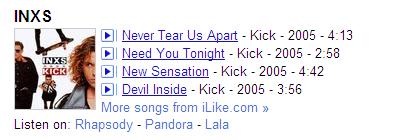
One major difference -- the Lala embeds usually featured the full track (for the first listen, at least), while the iLike application doesn't always stream the complete song. In some cases, you'll only hear the first 30 seconds or 1:30 of the song. A link to Lala remains, along with links to Rhapsody and Pandora.
tags: digital music Google music search GOOG Lala Apple AAPL Rhapsody Pandora
link 2 comments e-mail listen to the Layaways on Spotify
Follow @digitalaudio Tweet
April 30, 2010
Bye Bye Lalaby David Harrell
Apple will pull the plug on the Lala music streaming service on May 31st. From an e-mail sent this morning to Lala members:
The Lala service will be shut down on May 31st.link 0 comments e-mail listen to the Layaways on Spotify
In appreciation of your support over the last five years, you will receive a credit in the amount of your Lala web song purchases for use on Apple's iTunes Store. If you purchased and downloaded mp3 songs from Lala, those songs will continue to play as part of your local music library.
Remaining wallet balances and unredeemed gift cards will be converted to iTunes Store credit (or can be refunded upon request). Gift cards can be redeemed on Lala until May 31st.
Follow @digitalaudio Tweet
April 28, 2010
Some Quick Thoughts on the Quirk Presentationby David Harrell
Tim Quirk's presentation on the Walkman to the iPod and how portability and infinite storage changed the way we listen to music is a great read. And I completely agree that it's a shame that traditional radio formats are so narrow. It's hard to discover great new music if everything you listen to comes from the same genre or subgenre.
That said, I can't help thinking that his interpretation of the musical open-mindedness of Guns N' Roses fans is a little too generous. Quirk notes that Big Champagne data on P2P traffic reveals some surprising diversity in the music libraries of GNR fans -- more than a third of those listeners also have tracks from Tim McGraw, Kenny Chesney, and Garth Brooks. Quirk asks the rhetorical question, how many radio stations play all four of these artists?
After reading Quirk's post, Glenn Peoples at Billboard conducted a quick experiment and reported that the first three subsequent artists played on a Pandora Guns N' Roses station were Bon Jovi, AC/DC, and Metallica, even though, based on the Big Champagne data, Eminem and Black Eyed Peas had much higher GNR correlations those rock artists (and the three country acts above). Earlier today, I did the same thing on Last.fm and the first five subsequent artists were Aerosmith, Izzy Stradlin, Skid Row, Sebastian Bach, and Gilby Clarke.
So are GNR fans ill served by Pandora and Last.fm? The underlying methodologies for these two services are a very different, but it's probably safe to say that neither is likely to serve up tracks by Tim McGraw or Black Eyed Peas on a Guns N' Roses station. Yet even though it'd be wonderful if streaming services pushed the boundaries more on musical genres, I'd argue that the majority of those GNR listeners might not want to hear those artists.
Please don't get me wrong -- I'm not arguing for musical conservatism, I think almost every music fan could stand to expand his or her listening range. But a listener who likes Guns N' Roses enough to launch a GNR station on Pandora or Last.fm is no doubt a completely different listener than someone who just happens to have a GNR track in his or her library. (Especially when you consider that the tracks arrived there via a P2P service.) The former listener is a somewhat dedicated fan, the latter might just be someone who has fond memories of "Sweet Child O' Mine" and other 80s music and nabbed the track from a P2P service, but doesn't have much interest in the rest of the band's catalog.
Despite the correlations reported by Big Champagne, none of Last.fm's top 250 similar artists to Guns N' Roses (as determined by actual tracks played by listeners) are outside of the hard rock, metal, or rock genres. While I truly believe that fans of one genre like and appreciate great songs from completely different genres, unless the Big Champagne data shows a similar overlap in the number of listens, as opposed to a mere shared presence on a hard drive, it doesn't indicate that any given Guns N' Roses fan is open to hearing Black Eyed Peas, Eminem, or Kenny Chesney.
tags: digital music Big Champagne Pandora Last.fm Tim Quirk
link 2 comments e-mail listen to the Layaways on Spotify
Follow @digitalaudio Tweet
April 26, 2010
Monday Odds and Endsby David Harrell
CD Baby will now distribute a digital single for $9, with no ongoing annual fee. No specific mention was made of an ongoing commission, but I'm assuming it's the same 9% charged for digital sales of digital albums and individual songs from those albums.
Last week's New Yorker had a great piece on the iPad and the Kindle, and the economics of digital books. Also from that issue, Least Common Complaints About the New iPad.
From Sunday's NY Times Magazine piece on the National:
"The corporate model has collapsed, but small-label bands playing to 200 people a night can pay the bills and raise a family on it. That's why we’ll have better and more interesting innovations."You can stream the band's new album from the NY Times article and a free download of "Bloodbuzz Ohio" is available here.
Senzoo is a new widget for soliciting online donations.
The transcript of Apple's earnings call from last week.
And BusinessWeek (or "Bloomberg Businessweek" as it's now billed) has a piece on Apple's app strategy:
For Apple, it's a Wintel-like cycle in which new Apple hardware drives the creation and purchase of new apps. Except it's better than Wintel; the combination of Intel processor running Microsoft's Windows operating system never really managed to leap from PCs to other devices. Apple has constructed its empire so that almost anything you buy on iTunes -- and Apple has your credit-card information with your first purchase -- can run on any future iProduct. "The laws of nature say that [Apple is] making too much damn money, that this has to be unsustainable," says David J. Eiswert, who runs T. Rowe Price's (TROW) $312 million Global Technology Fund (PRGTX). "But who is going to stop them?"tags: digital music CD Baby Apple AAPL
link 1 comments e-mail listen to the Layaways on Spotify
Follow @digitalaudio Tweet
April 21, 2010
Our First Spotify Payoutsby David Harrell

As the old saying goes, if you lose money on each sale, you can make up for it with volume. I thought of it when the first payouts for Spotify streams showed up in our CD Baby account last week. (CD Baby began delivering content to Spotify in early 2009.)
The payments, of course, aren't negative amounts. Yet the amounts for individual streams are small enough that it will take an extremely large volume to add up to any significant amount.
For August and September of 2009, we received per-stream payouts of .02 cents, .03 cents, .06 cents, and -- my favorite -- an amount so small that it apparently rounds to .000000 cents! These numbers are all after CD Baby's 9% commission, so the actual payouts from Spotify were approximately .022 cents, .033 cents, and .066 cents per stream. I'm assuming that the different amounts represent streams by different Spotify user types (free, day pass, and premium) and/or regions.
A couple years ago, Glenn Peoples discussed the disparity between per-stream payouts and those for actual digital downloads, noting that it takes 70 plays at a one-cent payout to equal the revenue generated by a single paid download. At the .022 cent rate, the disparity is much greater -- it would require 3,500 Spotify plays to generate the same payout as that from a 99-cent iTunes download.
So when Spotify listeners (both free and subscription) use the service as a direct substitute for the purchase of music, then it likely has negative consequences for music labels. On the other hand, when services like Spotify steer some listeners away from P2P downloads, it's a positive for labels, even if the amounts are small.
Finally, you can make an argument in favor of the streaming services when they're used to stream music that the listener already owns. That is, once you buy a song (on CD or as a digital download) that's the end of the revenue stream for the label and artist, no matter how many times you listen to it. But if you listen to a track or album you already own via a streaming service, you make an additional micro-payment to the artist and label with each play.
tags: digital music Spotify streaming royalties
link 3 comments e-mail listen to the Layaways on Spotify
Follow @digitalaudio Tweet
April 19, 2010
A Long Tail Experimentby David Harrell

Last spring, some research by Will Page (PDF), the in-house economist for PRS (the U.K. equivalent of BMI and ASCAP), received a ton of coverage. Page believed his numbers refuted the "Long Tail" theory, at least for music consumption. The sales figures for the U.K. iTunes store revealed that -- unlike the trends observed by Chris Anderson of the listening habits of Rhapsody subscribers -- the majority of tracks in the iTunes catalog had never been purchased. At the time, arguments were made about the shape of the sales curve and whether or not Page was using the same definitions as Anderson. (Page seemed to imply that the theory predicted that 80% of sales would come from the tail, while Anderson gave a much smaller percentage.) These details aside, the fact remains that Page's research revealed that most digital tracks weren't purchased, a seeming contradiction of the main music example in Anderson's original 2004 Wired article and his subsequent book.
Yet it's not difficult to reconcile these results -- Page and Anderson might both be right. Keep in mind that the music example Anderson gave in the original 2004 Wired article was based on data from a Rhapsody catalog that included less than 1 million tracks. Page examined sales from a catalog of more than 10 million tracks, so it's really no surprise that he saw a much larger number of "dormant" tracks.
The other thing to consider is that there's probably a huge difference in usage within a subscription service vs. sales within a download store. If you're a subscriber to Rhapsody, Napster, or Netflix, there's no additional cost associated with any individual song or film you choose to consume. Indeed, Anderson suggests so in a response to the initial reports of the Page research:
It could be that the pay-per-track model discourages risk-taking and exploration of new music, which is not an issue with Rhapsody, which uses an all-you-can-eat subscription model.While eMusic phased out the "all you can eat" component of its subscription service years ago, the behavior its subscribers seems closer to that described by Anderson than that observed by Page. An early 2009 press release, which referred to the PRS study, touted the fact that approximately 75% of the eMusic catalog was downloaded at least once in the prior year.
Although tangential to the dormant track conundrum, another issue with the "Long Tail" theory for music sales is that it has too frequently been misinterpreted to imply that artists could somehow expect to earn money from "Long Tail" sales. Anderson, of course, never made that claim -- he suggested that aggregators of content (retailers and service providers such as Amazon.com, iTunes, eMusic, Netflix, etc.) were the ones who would profit from the Long Tail phenomenon, not the individual creators of that content. As I've noted here before, a single play by a Rhapsody subscriber might be enough to include the track in the Long Tail of music consumption, but that single play results in a payment of approximately one cent, hardly enough to think of as actual income.
Back in August, I started a Long Tail experiment of sorts. My current band, the Layaways, is something of a Long Tail act, in that while relatively unknown, we've consistently sold something, if only a few downloads, every month for the past five years. But I was curious to see what might happen with a music act without any Internet footprint, a defunct band with no website and no material currently for sale in any form -- CD, mp3, etc.
So I uploaded a single song from one of my very first bands to Last.fm, making it available for streaming and free download. This group existed in the dark ages before mp3s and music blogs, and we released three "cassette only" albums (we were too broke to release anything on CD or vinyl!). While we sold a few hundred cassettes at gigs and local record stores, as far I could tell, nothing from them had ever made it online in any form. I tagged the track a few times with appropriate descriptions and waited to see what happened.
Nearly eight months later, 30 listeners have heard the song 50 times. The most-frequent listener of the song has played it 10 times and it has been added to one playlist. (I'm not disclosing any details about the song or linking to here because I'd like to keep the experiment running.) Last.fm doesn't supply stats on how many times a free track has been downloaded, so I don't know how many of those listeners liked the song enough to acquire a free mp3 version of it.
I'm not sure if this result proves anything about the Long Tail -- the only thing I can safely say is that if something is uploaded to Last.fm and tagged, someone will hear it. Perhaps this is simply a testament to the popularity of Last.fm and how its tag-based streaming radio service works. The song I uploaded isn't available for sale anywhere, so I don't know if anyone would have actually paid for it. Besides, given how subjective musical tastes are, it's difficult to read that much into what happened with a single song. If an equally unknown song were deemed an undiscovered classic by the first few people to hear it, perhaps it might have taken off somehow, if those listeners were inspired to share or promote it.
But despite the relative "success" of my mystery song, one thing seems certain: The amount of available digital music has increased enormously since the original Long Tail article, and it will continue to expand each year. Unless the number of music listeners and their aggregate listening hours increase at a similar rate (I doubt they will), it seems likely that the both the number and percentage of dormant/unpurchased tracks will continue to increase as digital music catalogs grow.
tags: digital music the Long Tail Chris Anderson Will Page Rhapsody Last.fm iTunes eMusic
link 3 comments e-mail listen to the Layaways on Spotify
Follow @digitalaudio Tweet
April 16, 2010
Feeling Cheapby David Harrell
As a fan of the Cars, I was happy to see the addition of the group's entire catalog to eMusic this week. (The Led Zeppelin catalog was another major addition.) I own the band's first two albums but there are several tracks from their later releases that I wanted to pick up.
But my enthusiasm cooled somewhat when I saw that the Cars' catalog is only available as "album only." Given that my iTunes library is now more than 10,000 tracks (and I've barely ripped half of my CD collection to mp3), I've started to cherry pick, especially for older material. And even though it'd only cost me $4 to download the entire "Panorama" album from eMusic, I can nab the one song I really wanted, "Touch and Go," for 99 cents from Amazon MP3.
Don't get me wrong -- as an eMusic subscriber, I'm glad for the additions to the catalog. And if major labels opt to make some of their releases "album only," that's OK with me. I'd rather have them there with restrictions than not at all. Yet I'm now more likely to download new releases as full albums. For older material that I'm already familiar with, I'd rather just get my favorite tracks.
UPDATE: In this particular case, there's a workaround -- while the album it's from is "album only," the track is available from eMusic a la carte on this greatest hits collection.
tags: digital music the Cars eMusic
link 0 comments e-mail listen to the Layaways on Spotify
Follow @digitalaudio Tweet
More Digital Audio Insider: Newer Posts Older Posts
Subscribe:
 RSS Feed
Add this blog to Del.icio.us, Digg, or Furl. Follow David Harrell on Google+.
The Digital Audio Insider Twitter feed:
Digital music jobs: Looking to hire? Looking for a job? Check out the digital audio insider job board.
Popular Posts
A Long Tail Experiment
By the Numbers: Using Last.fm Statistics to Quantify Audience Devotion
Lala.com Owes Me Sixty Cents
An Interview with Jonathan Segel of Camper Van Beethoven
Price Elasticity of Demand for McCartney
Sony and eMusic: What I Missed
The Digital Pricing Conundrum series:
Part One Part Two Part Three Part Four
THE LAYAWAYS
Out Now -- "Maybe Next Year" -- The New Holiday Album:
"This is a sweet treat, deliciously musical without being overbaked for mass media consumption." -- Hyperbolium
"Perfect listening to accompany whatever holiday preparations you may be making today." -- Bag of Songs
O Christmas Tree - free mp3 lyrics and song details
Away In A Manger - free mp3
Download from eMusic, iTunes, Amazon MP3, or Bandcamp. Listen to free streams at Last.fm.

"...about as melodic and hooky as indie pop can get." -- Absolute Powerpop
"Their laid-back, '60s era sounds are absolutely delightening." -- 3hive
"...melodic, garage-influenced shoegaze." -- RCRD LBL
Where The Conversation Ends - free mp3
January - free mp3
Keep It To Yourself - free mp3
Download from eMusic, iTunes, Amazon MP3, or CD Baby, stream it at Last.fm or Napster.

"The Layaways make fine indie pop. Hushed vocals interweave with understated buzzing guitars. The whole LP is a revelation from the start." -- Lost Music
"Catchy Guided by Voices-like rockers who lay it on sweetly and sincerely, just like Lionel Richie." -- WRUV Radio
Silence - free mp3 lyrics and song details
The Long Night - free mp3
Download from eMusic, Amazon MP3, or iTunes, stream it at Last.fm, Napster, or Rhapsody.

"These are songs that you want to take home with you, curl up with, hold them close -- and pray that they are still with you when you wake up." -- The Big Takeover
Let Me In - free mp3
Ocean Blue - free mp3
Download from eMusic, Amazon MP3, or iTunes, stream it at Last.fm, Napster, or Rhapsody.
More Layaways downloads:


the layaways website