
home
about/contact
Digital Audio Insider is David Harrell's blog about the economics of music and other digital content. I write from the perspective of a musican who has self-released four albums with the indie rock band the Layaways.
My personal website has links to my LinkedIn and Google+ pages and you can send e-mail to david [at] thelayaways [dot] com.
As an Amazon Associate I earn from qualifying purchases.
Support
If you enjoy this site, please consider downloading a Layaways track or album from iTunes, Amazon MP3, Bandcamp, or eMusic. CDs are available from CD Baby and Amazon.
links
music/media/tech:
Analog Industries
Ars Technica
AppleInsider
Brad Sucks Blog
Broken Record
Digital Music News
Duke Listens
Future of Music Coalition Blog
Hypebot
LA Times Technology Blog
The ListeNerd
Medialoper
Mediashift
MP3 Insider
Music Ally
Music Machinery
Music Think Tank
MusicTank
The Music Void
New Music Strategies
Online Fandom
Pakman's Blog
RAIN
Rough Type
RoughlyDrafted
Swindleeeee
TuneTuzer
Virtual Economics
economics/markets:
The Big Picture
Core Economics
Freakonomics
The Long Tail
Marginal Revolution
The Undercover Economist
mp3/music:
17 Dots
3hive
Fingertips
Shake Your Fist
Sounds Like the 80s
Unleash the Love
archives
January 2006
February 2006
March 2006
April 2006
May 2006
June 2006
July 2006
August 2006
September 2006
October 2006
November 2006
December 2006
January 2007
February 2007
March 2007
April 2007
May 2007
June 2007
July 2007
August 2007
September 2007
October 2007
November 2007
December 2007
January 2008
February 2008
March 2008
April 2008
May 2008
June 2008
July 2008
August 2008
September 2008
October 2008
November 2008
December 2008
January 2009
February 2009
March 2009
April 2009
May 2009
June 2009
July 2009
August 2009
September 2009
October 2009
November 2009
December 2009
January 2010
February 2010
March 2010
April 2010
May 2010
June 2010
July 2010
September 2010
October 2010
November 2010
December 2010
January 2011
February 2011
March 2011
April 2011
May 2011
June 2011
July 2011
August 2011
September 2011
October 2011
November 2011
December 2011
January 2012
February 2012
April 2012
May 2012
June 2012
August 2012
October 2012
November 2012
December 2012
January 2013
February 2013
March 2013
June 2013
August 2013
February 2014
March 2014
September 2014
December 2014
March 2015
October 2015
November 2015
December 2015
October 2016
May 2017
May 2025
October 04, 2011
The Flaw in the Standard Apple vs. Amazon Digital Pricing Storyby David Harrell
Amazon's price for the upcoming Kindle Fire ($199) conforms to the storyline that has emerged over the last year or so about the respective digital pricing strategies of Amazon and Apple. That is, Apple's happy to break even on digital content sales because its iPods, iPhones, and iPads are so profitable, while Amazon prices its hardware aggressively to encourage the sales of profitable digital content.
But there's a slight problem with this narrative: digital content is often cheaper at Amazon. For example, as of this afternoon, the top 10 tracks in the iTunes store are selling for $1.29 each, while eight of those songs are available for just 99 cents each at Amazon MP3. You'll find a similar trend for digital albums -- most of the top 10 sellers are less expensive at Amazon MP3. (Due to the switch to the "agency model," prices for the best-selling digital books are usually the same in both stores.)
Unless Amazon is losing money on all of this digital content in order to build its market share (that's clearly happening in certain cases), the digital content sold by Apple is probably more profitable than generally assumed. (Way back in 2008, Saul Hansell suggested that Apple was sandbagging when it discussed the profitability of iTunes sales.) If so, it means Apple has been able to exact a premium price for both its hardware devices and the digital content that fills them.
Update: After I posted a link to this story on Google+, my friend Aaron made a comment about the role of content providers in setting prices, something I probably should've addressed in the original post. As far as I know, Apple and Amazon pay the same wholesale prices to labels and digital distributors. Yet Amazon is consistently using a smaller markup for its retail prices. While the premium Apple commands for its hardware is easy to explain (design, usability, brand appeal, etc.), the willingness for consumers to pay higher prices to Apple for identical digital content is harder to understand. I suppose it comes down to the convenience of the single system, even though music purchased from Amazon will download directly to your iTunes library!
Labels: Amazon, Apple, digital music pricing
link 0 comments e-mail listen to the Layaways on SpotifyFollow @digitalaudio Tweet
September 26, 2011
Monday Odds and Ends: Beatles Editionby David Harrell
I'm a life-long Beatles fan, but this bit from Peter Doggett's "You Never Give Me Your Money" was news to me:
In a strange precursor of the 'Home taping is killing music' campaign of the 1980s and the 21st century concern about illegal downloads, Lennon and McCartney feared that record sales would suffer if the newly devised cassette tape recorder went into mass circulation. Mardas developed an electronic signal that could be added to recorded sound to prevent it being copied. 'It seemed quite possible,' noted commentator Tony Palmer in 1969, 'that within a few years, every single record sold anywhere in the world would carry this device, and thus pay to the Beatles a royalty.'The Wall Street Journal collects some negative quotes about the band, from "10 Ways to Recycle a Corpse" by Karl Shaw.
And nearly one year after the introduction of Beatles music to the iTunes catalog, George Harrison's "Here Comes the Sun" remains the top-selling digital Beatles track. Harrison compositions also account for three of the top-12 tracks on the group's Last.fm listener chart. As a composer, Harrison famously had to fight for space on Beatles albums -- I wonder if the emergence of this type of data has altered the internal dynamics of modern bands with multiple songwriters. It not just ego or the struggle for artistic expression -- songwriting and performance royalties (the latter are paid only to the composer and publisher for terrestrial radio play in the U.S.) often dwarf those from music sales and can result in huge income disparities among band members.
tags: digital music iTunes the Beatles George Harrison
link 0 comments e-mail listen to the Layaways on Spotify
Follow @digitalaudio Tweet
September 06, 2011
Tuesday Odds and Ends: Unlimited Cloud Music Storage from Amazonby David Harrell
I opened my Amazon Cloud Player for the first time in a while and noticed that Amazon has quietly (no press release, I believe) upped the storage limits for mp3 and AAC music files, perhaps in an anticipation of the release of Apple's iTunes Match. All paid Amazon Cloud storage plans now include unlimited space for music files:

BTW, my "$20 a year" subscription was a freebie upgrade after purchasing a $2.99 album from Amazon MP3. Cloud storage isn't free, but if anyone can afford to give it away, it's Amazon.
From a Billboard interview -- why Lindsey Buckingham opted to self-release his new album:
How did you go from lifelong major-label artist to self-releasing Seeds We Sow?Finally, I haven't digested the entire piece, but the following paragraph was excerpted on Andrew Sullivan's blog and it got me thinking about ego gratification and self-released musicians:
My deal with Warner Bros. had expired. Trying to shop this album was kind of like starting over. I actually started [shopping] with Warner Bros. [chairman] Rob Cavallo, who is a friend of mine and is in this new position over there. Rob liked it a lot, and then he had to go back and deal with the people in Burbank [Calif.], and when I talked to him on the phone, he started talking about the numbers he had to make quarterly, and I thought, "Well, that's the end of that." I did talk to a few independent labels and finally decided that what they were doing was something I could probably just as easily do myself.
I'm astonished at how readily a great many people I know, young people, have accepted a reduced economic prospect and limited freedoms in any substantial sense, and basically traded them for being able to screw around online. There are just a lot of people who feel that being able to get their video or their tweet seen by somebody once in a while gets them enough ego gratification that it's okay with them to still be living with their parents in their 30s.Without the new forms of gratification that the Internet has enabled for musicians -- music blog posts and reviews, Last.fm listening stats, etc. -- would we see much less self-released music? It's not the primary reason I record and release music, but there is a level of feedback/audience reach available today that was unimaginable a decade or so ago, and it's a "payment" of sorts for your efforts. Back in the day, a self-released album could easily disappear without a trace. Today, you can at least count on a minimal amount of online attention, even if sales are minimal.
tags: digital music Amazon AMZN iTunes self-released music
link 2 comments e-mail listen to the Layaways on Spotify
Follow @digitalaudio Tweet
August 26, 2011
Friday Flashback Fun: 1983 Apple Commercialby David Harrell
I don't have anything profound to say about Wednesday's news about Steve Jobs, but it somehow reminded me of something I posted a few years back -- this 1983 Apple commercial, where Kevin Costner bikes to the office on the weekend (with the family dog) to work all on night on his Apple computer:
Labels: 1980s, 1983, Apple, Kevin Costner
link 0 comments e-mail listen to the Layaways on SpotifyFollow @digitalaudio Tweet
August 05, 2011
Friday Flashback Fun: Time Magazine's October 2000 Cover Story on Napsterby David Harrell

Time flies -- it's hard to believe that this was all happening more than a decade ago:
The issue may come down to what Napster lead attorney David Boies, who successfully prosecuted the Department of Justice's case against Microsoft, describes as "the definition of commercial or noncommercial uses." It is perfectly legal for consumers to copy music for their own enjoyment--i.e., noncommercial use. Congress has even declared, in the Audio Home Recording Act of 1992, that it is legal to make recordings and lend them out to people, provided it is not done for commercial purposes. It is unlawful, of course, if it's done to make a profit. "The law does not distinguish between large-scale and small-scale sharing or lending," insists Boies, who puts Napster's chance of winning the suit at fifty-fifty.
Labels: 2000, 2000s, file sharing, Friday Flashback Fun, Napster
link 0 comments e-mail listen to the Layaways on SpotifyFollow @digitalaudio Tweet
July 27, 2011
Is Apple's Stock a Buy? Either Way, You Probably Already Own Itby David Harrell
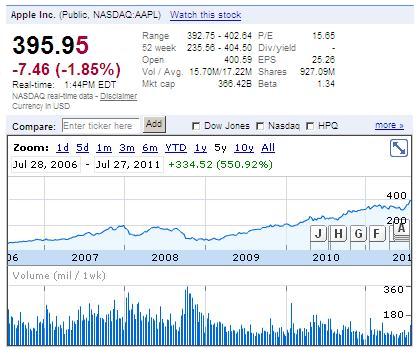
Apple's stock has had quite the run over the past few years -- it's up more than 290% since the beginning of 2009 and it closed yesterday at more than $400 a share. Even though Apple (AAPL) is only about the 35th largest company in the U.S. when measured by total revenue, in terms of total market capitalization (the total value of all of its shares), it's now the second biggest public company in the U.S.
Some stock analysts, including those at Morningstar (my employer) argue that Apple has established some unique competitive advantages over its rivals. Others are more pessimistic, pointing to concerns such as the health issues of CEO Steve Jobs, the potential vulnerability of having such large percentage of revenue coming from the iPhone line, and that relatively expensive products put Apple at a disadvantage in some markets.
Yet whatever your opinion of the prospects of Apple, and even if you've never considered purchasing the stock, you probably already own some of it. Apple is the second-largest component of the S&P 500 index and most retirement plans include index funds that seek to mimic the performance of the S&P by holding most (if not all) of its underlying components. So if you invest in such a fund via a 401(k) or 403(b) retirement plan, you currently own approximately $3 of Apple stock for every $100 invested in that fund. And some actively-managed stock funds have an even larger percentage of their assets invested in Apple. (In interest of full disclosure, I own exactly three shares of Apple directly and have additional exposure to the stock via my mutual fund holdings.)
You can, of course, say the same thing about most large public companies. That is, if you hold stock mutual funds, you own, indirectly, most well known firms, including other tech giants such as Google, Microsoft, and IBM. But if you're a fan of Apple products, perhaps it's some consolation to know that a portion of the money you've spent on your iPod, iPad, or iPhone might -- in theory -- make its way back to you if it helps increase the price of Apple's stock.
tags: digital music Apple AAPL
link 1 comments e-mail listen to the Layaways on Spotify
Follow @digitalaudio Tweet
July 22, 2011
Friday Flashback Fun: Rock Stars and Their Parents in 1971by David Harrell
Here's the main reason I really want an iPad (or the upcoming tablet from Amazon): The amazing collection of magazines scanned at Google Books. You can't print or download them, so a tablet computer seems like the ideal way to browse and read them.
This 1971 Life cover story is a trip, with photos of various music stars with their parents, including Elton John at the tender age of 24.
Labels: Friday Flashback Fun, Google Books, Life Magazine
link 0 comments e-mail listen to the Layaways on SpotifyFollow @digitalaudio Tweet
July 21, 2011
A Funny Spotify Experiment: Why Judas Priest Sounds Just Like Jerry Reedby David Harrell

The fact that the Spotify interface allows you to play tracks stored in your iTunes and Windows Media libraries made me wonder what happens when you use Spotify to "stream" a track you already own. From a performance standpoint, it makes sense for Spotify to pull the file from your hard drive. And doing so would also -- in theory -- relieve Spotify of any obligation to compensate the record company for that play, as the situation would be no different than listening to a track in iTunes.
After a quick experiment, I can confirm that Spotify (at least the free subscription I'm using) will default to a local file, if one is available.
I deliberately looked for a song on Spotify that I didn't own, the Judas Priest classic "Living After Midnight," and noted its length. I then searched my iTunes library for songs with the exact same length and Jerry Reed's "She Got the Goldmine (I Got the Shaft)" seemed the most ridiculous match (yes, for some reason I actually downloaded that song from eMusic...). I made a copy of the mp3 file and changed the ID tags of the copy to match the artist, song title, and album for "Living After Midnight."
Sure enough, when I play "Living After Midnight" using Spotify, I hear Jerry Reed instead of Judas Priest. However, the song appears multiple times in the Spotify catalog on different compilation records. So if I stream a version from a different album, I hear the actual Judas Priest song, as served up by Spotify. As it turns out, the song lengths don't need to match, just the ID tags -- "Hell Bent for Leather" now sounds exactly like the Flaming Lips...
Judas Priest -- Living After Midnight:
Jerry Reed -- She Got the Goldmine (I Got the Shaft):
related: More On Spotify, A Very Quick Spotify Review, Spot the Spotify Payment, Our First Spotify Payouts
tags: digital music Spotify music subscriptions Judas Priest Jerry Reed
link 3 comments e-mail listen to the Layaways on Spotify
Follow @digitalaudio Tweet
More Digital Audio Insider: Newer Posts Older Posts
Subscribe:
 RSS Feed
Add this blog to Del.icio.us, Digg, or Furl. Follow David Harrell on Google+.
The Digital Audio Insider Twitter feed:
Digital music jobs: Looking to hire? Looking for a job? Check out the digital audio insider job board.
Popular Posts
A Long Tail Experiment
By the Numbers: Using Last.fm Statistics to Quantify Audience Devotion
Lala.com Owes Me Sixty Cents
An Interview with Jonathan Segel of Camper Van Beethoven
Price Elasticity of Demand for McCartney
Sony and eMusic: What I Missed
The Digital Pricing Conundrum series:
Part One Part Two Part Three Part Four
THE LAYAWAYS
Out Now -- "Maybe Next Year" -- The New Holiday Album:
"This is a sweet treat, deliciously musical without being overbaked for mass media consumption." -- Hyperbolium
"Perfect listening to accompany whatever holiday preparations you may be making today." -- Bag of Songs
O Christmas Tree - free mp3 lyrics and song details
Away In A Manger - free mp3
Download from eMusic, iTunes, Amazon MP3, or Bandcamp. Listen to free streams at Last.fm.

"...about as melodic and hooky as indie pop can get." -- Absolute Powerpop
"Their laid-back, '60s era sounds are absolutely delightening." -- 3hive
"...melodic, garage-influenced shoegaze." -- RCRD LBL
Where The Conversation Ends - free mp3
January - free mp3
Keep It To Yourself - free mp3
Download from eMusic, iTunes, Amazon MP3, or CD Baby, stream it at Last.fm or Napster.

"The Layaways make fine indie pop. Hushed vocals interweave with understated buzzing guitars. The whole LP is a revelation from the start." -- Lost Music
"Catchy Guided by Voices-like rockers who lay it on sweetly and sincerely, just like Lionel Richie." -- WRUV Radio
Silence - free mp3 lyrics and song details
The Long Night - free mp3
Download from eMusic, Amazon MP3, or iTunes, stream it at Last.fm, Napster, or Rhapsody.

"These are songs that you want to take home with you, curl up with, hold them close -- and pray that they are still with you when you wake up." -- The Big Takeover
Let Me In - free mp3
Ocean Blue - free mp3
Download from eMusic, Amazon MP3, or iTunes, stream it at Last.fm, Napster, or Rhapsody.
More Layaways downloads:


the layaways website