
home
about/contact
Digital Audio Insider is David Harrell's blog about the economics of music and other digital content. I write from the perspective of a musican who has self-released four albums with the indie rock band the Layaways.
My personal website has links to my LinkedIn and Google+ pages and you can send e-mail to david [at] thelayaways [dot] com.
As an Amazon Associate I earn from qualifying purchases.
Support
If you enjoy this site, please consider downloading a Layaways track or album from iTunes, Amazon MP3, Bandcamp, or eMusic. CDs are available from CD Baby and Amazon.
links
music/media/tech:
Analog Industries
Ars Technica
AppleInsider
Brad Sucks Blog
Broken Record
Digital Music News
Duke Listens
Future of Music Coalition Blog
Hypebot
LA Times Technology Blog
The ListeNerd
Medialoper
Mediashift
MP3 Insider
Music Ally
Music Machinery
Music Think Tank
MusicTank
The Music Void
New Music Strategies
Online Fandom
Pakman's Blog
RAIN
Rough Type
RoughlyDrafted
Swindleeeee
TuneTuzer
Virtual Economics
economics/markets:
The Big Picture
Core Economics
Freakonomics
The Long Tail
Marginal Revolution
The Undercover Economist
mp3/music:
17 Dots
3hive
Fingertips
Shake Your Fist
Sounds Like the 80s
Unleash the Love
archives
January 2006
February 2006
March 2006
April 2006
May 2006
June 2006
July 2006
August 2006
September 2006
October 2006
November 2006
December 2006
January 2007
February 2007
March 2007
April 2007
May 2007
June 2007
July 2007
August 2007
September 2007
October 2007
November 2007
December 2007
January 2008
February 2008
March 2008
April 2008
May 2008
June 2008
July 2008
August 2008
September 2008
October 2008
November 2008
December 2008
January 2009
February 2009
March 2009
April 2009
May 2009
June 2009
July 2009
August 2009
September 2009
October 2009
November 2009
December 2009
January 2010
February 2010
March 2010
April 2010
May 2010
June 2010
July 2010
September 2010
October 2010
November 2010
December 2010
January 2011
February 2011
March 2011
April 2011
May 2011
June 2011
July 2011
August 2011
September 2011
October 2011
November 2011
December 2011
January 2012
February 2012
April 2012
May 2012
June 2012
August 2012
October 2012
November 2012
December 2012
January 2013
February 2013
March 2013
June 2013
August 2013
February 2014
March 2014
September 2014
December 2014
March 2015
October 2015
November 2015
December 2015
October 2016
May 2017
May 2025
October 13, 2010
The New eMusic: The Psychology of Dollars vs. Creditsby David Harrell

Until the eMusic changes go live next month, it's difficult to speculate exactly what the addition of the Universal catalog and a shift from credits to dollar amounts for purchases will mean. And at this point, I have no idea if eMusic's current business model of sharing 60% of subscriber revenue will persist, or if the company is switching to the iTunes/Amazon model, where it pays labels a wholesale price for each track sold and pockets the mark-up.
As I've written here before, under the current model, labels and artists benefit from the digital breakage that occurs when eMusic subscribers let their credits expire unused. (Subscription plans are "use it or lose it," there is no carryover feature.) In the past, the per-track payout from eMusic to labels has often approached or exceeded the nominal per-track price that the subscription plans suggest. That is, because eMusic subscribers collectively fail to use all of their allotted downloads, when the 60% of revenue amount is divided by the total number of downloaded tracks within a payout period, the resulting payout amount is much larger than the subscription plan packages would suggest. Based on previous payouts that I've seen for my own music in the eMusic catalog, it appears that breakage rates are as high as 40% to 50%.
But with a switch to per-track pricing, I'm wondering if those rates will decline. It's one thing to let your "credits" expire each month. (I've certainly done so, consoling myself that in--a very small way--I'm helping to boost the payout rate I'll see for my music.) The new eMusic interface, however, won't display your remaining credits, it'll show your remaining dollars for the period. And my guess is that subscribers will be more reluctant to lose their money than their credits, even if it means the exact same thing in practice. While the new system will feature a "loose change" component where small amounts (less than the price of single download) will roll over, if you have a balance of $12.99 at the end of the month, you'll lose it all. It seems likely that eMusic subscribers will find dollar amounts more dear than credits.
related: More On eMusic Payouts, eMusic's Per-Song Payout for Q1 2010
tags: digital music eMusic music subscriptions
link 0 comments e-mail listen to the Layaways on Spotify
Follow @digitalaudio Tweet
September 29, 2010
Jeff Bezos Was Rightby David Harrell
Back in July, when announcing the new Kindle lineup, Amazon.com CEO Jeff Bezos said, "At $139, you’re going to have multiple Kindles, not just one."
I'm now living in a two-Kindle house -- my wife and I purchased them as early birthday presents for each other. Previously, we had zero interest in purchasing an e-reader but the price cuts finally made us jump.
However, while I was quick to buy the hardware, I'm not so quick to spring for content for it. My main reason for purchasing a Kindle was all of the public domain material available for it. I was a biology major in college, but I'm somewhat embarrassed to say that I've never read the original versions of Darwin's The Voyage of the Beagle, The Origin of Species, and The Descent of Man, all available in the Kindle format from Archive.org. And if you're anything of a history buff, there's a virtually endless supply of original works. I loved River of Doubt, the story of Teddy Roosevelt's ill-fated 1913-1914 Brazilian journey, so I was thrilled to find a freebie version of Roosevelt's own account of the adventure.
The Kindle also functions as an extremely rudimentary mp3 player. You can play, pause, and skip songs, but that's about it -- we're talking a sub-iPod Shuffle functionality. It seems like the Kindle could easily provide a more robust music experience, but I'm guessing the minimalist approach was a strategic decision by Amazon to avoid direct comparisons to the iPod. The mp3 function is listed in the "Experimental" portion of the Kindle menu, so maybe there are plans for future improvements...
tags: Kindle Amazon.com AMZN e-reader digital books Jeff Bezos
link 0 comments e-mail listen to the Layaways on Spotify
Follow @digitalaudio Tweet
September 03, 2010
Digital Downloads: Not Just Competing With Freeby David Harrell
In general, the standard iTunes and Amazon MP3 album prices are less than what you'd pay for physical CDs at most retailers, with the exception of "loss leader" pricing at big box stores. And eMusic prices are even lower. But as many have noted, your best bet for picking up cheap digital music is used CDs.
I was reminded of this when my friend Michael posted a picture and list on Facebook of his sweet haul from Reckless Records in Chicago:
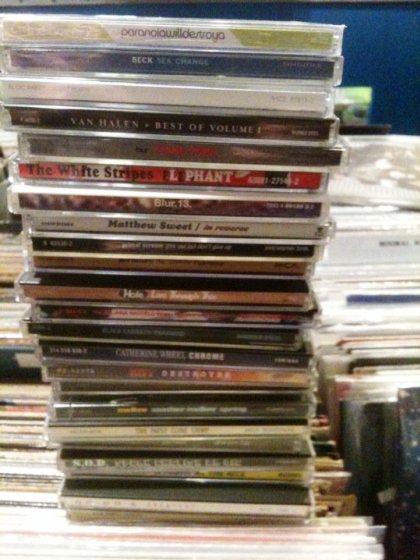
The Assembly - Paranoia Will Destroy Ya $.49Sure, it's crapshoot as to what you'll discover on any given visit to a used CD store (though you can always find this Jesus Jones release), but my guess is that almost all of these titles would reach the top of the Amazon MP3 chart if offered as daily specials at the above prices.
Catherine Wheel - Chrome $.49
Jimi Hendrix - The Ultimate Experience $1.99
Blur - Think Tank $.99
The Juliana Hatfield Three - Become What You Are $.49
S.O.D. - Speak English Or Die $1.99
The Smoking Popes - Get Fired $1.99
The Patsy Cline Story - $1.99
Van Halen - Best of Volume 1 $.99
Black Sabbath - Paranoid $1.99
Kiss - Destroyer $1.99
The White Stripes - Elephant $1.99
Bloc Party - Silent Alarm $1.99
Beck - Sea Change $1.99
Mellow - Another Mellow Spring $.49
Office - A Night At the Ritz - $.99
Go Go's - Greatest $.49
Fleetwood Mac - Greatest Hits $1.99
R.E.M. - Dead Letter Office $.99
Hole - Live Through This $.99
Primal Scream - Give Out But Don't Give Up $.99
Blur - 13 $.99
Matthew Sweet - In Reverse $.99
tags: digital music used CDs iTunes eMusic Amazon MP3
link 0 comments e-mail listen to the Layaways on Spotify
Follow @digitalaudio Tweet
July 22, 2010
Words and Music: Why Are Digital Books Already More Popular Than Digital Music Downloads?by David Harrell
Amazon.com, of course, doesn't represent the entire book market. Yet Monday's Amazon press release, which revealed that the company now sells 143 Kindle books for every 100 hardcover books sold, makes it clear that consumers are embracing digital books at a much faster rate than digital music.
So why has a book format introduced years after commercial digital music downloads already gained greater commercial acceptance? Some quick thoughts about the possible reasons why:
1. Existing Content
If you buy an iPod, you need something to put on it. Most music fans already own CDs that can be easily converted to mp3s. (We'll get to free/pirated music in a bit.) But you can't readily transfer your existing books to an e-reader. And even if you could, most people don't re-read their favorite books in the same way they listen to their favorite music over and over again. Frequent readers always need fresh content.
2. The Flexibility of CDs
When it comes to purchasing new music, the main advantage to buying digital downloads is the immediate delivery. However, if you're not in a hurry, purchasing a physical CD gives you much more flexibility. It delivers higher-quality sound files that can be converted into the file format of your choice, you can play the disc itself, and it serves as a back-up copy of the original WAV files.
3. The Unbundling Effect
The introduction of commercial digital downloads was more than a new medium/delivery format. It also meant that consumers were no longer forced to purchase an entire album if they only wanted one or two songs from that album. Perhaps the cherry picking of favorite tracks has contributed to modest growth of digital music sales relative to the total amount of music purchased on CD. With e-books, consumers don't have the option of cherry picking, and it seems unlikely that they'd do so, even if e-books could be purchased by the chapter. (With the exception of textbooks, as a comment to this post noted.)
4. Digital Books Are Relatively Cheaper Than Digital Albums?
Scratch that one. I started to write that unlike the prices of digital albums relative to CDs, digital books are almost always considerably cheaper than physical books. But a quick glance at Amazon's Kindle chart reveals that many of the bestselling digital books (like this one) are actually more expensive than the paperback or even hardback versions. This, however, might be a recent change -- before Amazon was forced to accept the agency model, it was selling many digital books as $9.99 loss leaders.
5. More Options for Free Music/Demographics
Two thoughts here: While there are hundreds of thousands of free, legal e-book titles, new releases are probably harder on P2P networks than new music.
There's also a demographic angle to consider. My guess is that, on average, the biggest consumers of music are younger than the biggest consumers of books. And, on average, younger consumers have less money, are more tech savvy, and are less likely to have qualms about not paying for copyrighted material. Older consumers, on the other hand, have more disposable income, are less tech savvy, and might be uncomfortable downloading pirated e-books, even if they were as readily available as music. Please don't get me wrong -- these are all broad generalizations. I'm not saying that all young people refuse to pay for music or that anyone over 40 doesn't have the know-how to download from a P2P network (or that young people don't read and older people don't listen to a lot of music). But if these general trends are true, they might have contributed to the faster growth of the digital book market.
What did I miss? If you have any other ideas or thoughts about why the switch to digital books is progressing faster than the changeover from CDs to music downloads, please leave a comment.
related: Digital Books vs. Digital Music
tags: digital music digital books e-books Amazon.com AMZN Kindle
link 4 comments e-mail listen to the Layaways on Spotify
Follow @digitalaudio Tweet
July 09, 2010
Friday Fun: The Layaways and The Man From U.N.C.L.E.by David Harrell
My band the Layaways has never released a video, but thanks to Rumblefish music licensing, which provides content for YouTube's AudioSwap functionality, there are currently several dozen videos with our music on YouTube. We receive a fraction of a cent for each play, though it hasn't been much of a moneymaker so far. Our quarterly royalty checks have all been for less than $10, but you never know...
This is my favorite of the lot: Someone edited together a bunch of scenes from The Man From U.N.C.L.E. to highlight the, uh, romantic tension between the two leads, Robert Vaughn and David McCallum. He used "I Got You Babe" by Sonny and Cher as the soundtrack, but after receiving a take-down notice from Warner Music, substituted "Silence" by the Layaways. It's somewhat random, but in quite a few places the lyrics actually seem to work with the video:
tags: digital music YouTube The Man From U.N.C.L.E The Layaways
link 0 comments e-mail listen to the Layaways on Spotify
Follow @digitalaudio Tweet
June 28, 2010
Monday Odds and Endsby David Harrell
This year's Bandwidth Conference is scheduled for August 19th and 20th in San Francisco.
A couple of new music listening tools: ExtensionFM is a browser extension for Chrome that creates a library of the mp3s on the pages you visit. And Playlistify creates and generates playlists for Spotify.
Finally, if you missed it, last month's Fingertips commentary on free music is definitely worth a read.
tags: digital music free music
link 0 comments e-mail listen to the Layaways on Spotify
Follow @digitalaudio Tweet
June 17, 2010
C'est Lala Vieby David Harrell
It's been two and a half weeks since Apple shuttered Lala.com and it's not an exaggeration to say that I miss the site every day. The "hear any song once for free" model was just about perfect. I'd stream albums while reading music reviews at Pitchfork, listen to tracks before deciding how to spend my monthly allotment of eMusic downloads, and it was always the first place I'd go to listen to a new (or old) album that I read about it. There are, of course, other options for streaming music online, but everything I tried in the past was inferior to the Lala experience. I had no luck with my Napster subscription (just couldn't get the music player to work on my PC), though I suppose I should try a Rhapsody or MOG subscription.
The question now is how much of Lala's functionality will Apple incorporate into iTunes. While much of the recent speculation has been about the cloud/digital locker feature, a digital locker functionality seems unlikely. Unless Apple follows the Google approach of pulling data from users' hard drives, the major label groups are likely to balk at cloud-based iTunes libraries. (See EMI's long-term harassment of Michael Robertson over digital lockers.) But what I'd most like to see in iTunes is some sort of music streaming capability, if only the "one-time free stream" option that Lala provided.
Historically, the economics have been challenging for streaming services. For paid subscription services, which can offer reasonable compensation (around one cent) to labels for each stream, the difficulty has been growing their subscriber bases. While millions of U.S. households are willing to pay for $30 or more each month for cable/satellite service, only a tiny percentage of the country appears to be willing to spend a smaller amount for music access. And the problem with free, ad-supported streams is that ad rates simply aren't high enough to allow the streaming services to offer reasonable payments to labels for each stream, let alone generate enough profit to support and grow the company. (See this recent post on Spotify payouts.)
Apple, however, should it choose to offer some sort of free streams via iTunes, has one major advantage over any other streaming music provider: It doesn't have to make money from it. Apple has famously claimed that it essentially breaks even on music sales from the iTunes store. Yet given how many high-margin iPods and iPhones Apples sells, it could even stand to lose money on iTunes music sales, provided that they encourage the purchase of Apple hardware. Ditto for free streams.
The numbers here are a little different, of course, as a one cent or 1/2 cent payout per stream means each song played is a net negative for Apple. But if a Lala-style "stream any song once" option encouraged additional iTunes music sales or iPod purchases, it could make sense for Apple.
Thank you to my friend Jeff Kelley for the title post!
Labels: Apple, iTunes, Lala.com, music streaming
link 5 comments e-mail listen to the Layaways on SpotifyFollow @digitalaudio Tweet
June 03, 2010
eMusic's Per-Song Payout for Q1 2010by David Harrell

After major changes to its subscription plans in the summer of 2009, the per-download payout from eMusic to the labels in its catalog continues to grow. For the first quarter of 2010, the payout rate for U.S. downloads was 40 cents, a slight increase over the Q4 2009 payout of 39 cents. That amount, however, is more than a 30% increase over the payout rate for the same quarter in 2009.
For comparison, here are the payout rates for the past five quarters:
Q1 2009 30.5 centsA quick primer for those unfamiliar with the eMusic model: Rather than paying a fixed per-song amount like iTunes and Amazon MP3, eMusic shares 60% of its subscriber revenue, minus certain deductions, with the labels in its catalog. That shared revenue translates into a per-track amount, based on total subscriber download activity for the quarter.
Q2 2009 33.4 cents
Q3 2009 34.2 cents
Q4 2009 39 cents
Q1 2010 40 cents
related: eMusic's Per-Song Payout for Q4 2009, eMusic's Per-Song Payout for Q3 2009, eMusic's Per-Song Payout for Q2 2009, Sony and eMusic: Why the Per-Track Label Payout Might Not Change
tags: digital music eMusic eMusic royalty iTunes
link 2 comments e-mail listen to the Layaways on Spotify
Follow @digitalaudio Tweet
More Digital Audio Insider: Newer Posts Older Posts
Subscribe:
 RSS Feed
Add this blog to Del.icio.us, Digg, or Furl. Follow David Harrell on Google+.
The Digital Audio Insider Twitter feed:
Digital music jobs: Looking to hire? Looking for a job? Check out the digital audio insider job board.
Popular Posts
A Long Tail Experiment
By the Numbers: Using Last.fm Statistics to Quantify Audience Devotion
Lala.com Owes Me Sixty Cents
An Interview with Jonathan Segel of Camper Van Beethoven
Price Elasticity of Demand for McCartney
Sony and eMusic: What I Missed
The Digital Pricing Conundrum series:
Part One Part Two Part Three Part Four
THE LAYAWAYS
Out Now -- "Maybe Next Year" -- The New Holiday Album:
"This is a sweet treat, deliciously musical without being overbaked for mass media consumption." -- Hyperbolium
"Perfect listening to accompany whatever holiday preparations you may be making today." -- Bag of Songs
O Christmas Tree - free mp3 lyrics and song details
Away In A Manger - free mp3
Download from eMusic, iTunes, Amazon MP3, or Bandcamp. Listen to free streams at Last.fm.

"...about as melodic and hooky as indie pop can get." -- Absolute Powerpop
"Their laid-back, '60s era sounds are absolutely delightening." -- 3hive
"...melodic, garage-influenced shoegaze." -- RCRD LBL
Where The Conversation Ends - free mp3
January - free mp3
Keep It To Yourself - free mp3
Download from eMusic, iTunes, Amazon MP3, or CD Baby, stream it at Last.fm or Napster.

"The Layaways make fine indie pop. Hushed vocals interweave with understated buzzing guitars. The whole LP is a revelation from the start." -- Lost Music
"Catchy Guided by Voices-like rockers who lay it on sweetly and sincerely, just like Lionel Richie." -- WRUV Radio
Silence - free mp3 lyrics and song details
The Long Night - free mp3
Download from eMusic, Amazon MP3, or iTunes, stream it at Last.fm, Napster, or Rhapsody.

"These are songs that you want to take home with you, curl up with, hold them close -- and pray that they are still with you when you wake up." -- The Big Takeover
Let Me In - free mp3
Ocean Blue - free mp3
Download from eMusic, Amazon MP3, or iTunes, stream it at Last.fm, Napster, or Rhapsody.
More Layaways downloads:


the layaways website