
home
about/contact
Digital Audio Insider is David Harrell's blog about the economics of music and other digital content. I write from the perspective of a musican who has self-released four albums with the indie rock band the Layaways.
My personal website has links to my LinkedIn and Google+ pages and you can send e-mail to david [at] thelayaways [dot] com.
Support
If you enjoy this site, please consider downloading a Layaways track or album from iTunes, Amazon MP3, Bandcamp, or eMusic. CDs are available from CD Baby and Amazon.
links
music/media/tech:
Analog Industries
Ars Technica
AppleInsider
Brad Sucks Blog
Broken Record
Digital Music News
Duke Listens
Future of Music Coalition Blog
Hypebot
LA Times Technology Blog
The ListeNerd
Medialoper
Mediashift
MP3 Insider
Music Ally
Music Machinery
Music Think Tank
MusicTank
The Music Void
New Music Strategies
Online Fandom
Pakman's Blog
RAIN
Rough Type
RoughlyDrafted
Swindleeeee
TuneTuzer
Virtual Economics
economics/markets:
The Big Picture
Core Economics
Freakonomics
The Long Tail
Marginal Revolution
The Undercover Economist
mp3/music:
17 Dots
3hive
Fingertips
Shake Your Fist
Sounds Like the 80s
Unleash the Love
archives
January 2006
February 2006
March 2006
April 2006
May 2006
June 2006
July 2006
August 2006
September 2006
October 2006
November 2006
December 2006
January 2007
February 2007
March 2007
April 2007
May 2007
June 2007
July 2007
August 2007
September 2007
October 2007
November 2007
December 2007
January 2008
February 2008
March 2008
April 2008
May 2008
June 2008
July 2008
August 2008
September 2008
October 2008
November 2008
December 2008
January 2009
February 2009
March 2009
April 2009
May 2009
June 2009
July 2009
August 2009
September 2009
October 2009
November 2009
December 2009
January 2010
February 2010
March 2010
April 2010
May 2010
June 2010
July 2010
September 2010
October 2010
November 2010
December 2010
January 2011
February 2011
March 2011
April 2011
May 2011
June 2011
July 2011
August 2011
September 2011
October 2011
November 2011
December 2011
January 2012
February 2012
April 2012
May 2012
June 2012
August 2012
October 2012
November 2012
December 2012
January 2013
February 2013
March 2013
June 2013
August 2013
February 2014
March 2014
September 2014
December 2014
March 2015
October 2015
November 2015
December 2015
October 2016
May 2017
May 2025
May 15, 2012
Tuesday Odds and Ends: Long Tail Content, Occupy This Albumby David Harrell
As noted in a comment by Glenn Peoples, the 90% figure is too high. Still, this analysis by Mark Mulligan suggests that a huge percentage of the iTunes catalog is made up of cover/tribute songs:
...I looked at the available tracks on iTunes for 10, randomly selected, top tier artists (see figure). The startling key takeaway is that on average just 10% of the tracks listed for an artist is actually music by that artist. And bear in mind that many of those tracks are duplicates. The average U2 song for example, is listed multiple times ranging from original albums, remastered albums, EPs, greatest hits, compilations etc.Over at the Atlantic, Alexis Madrigal looks at Shutterstock. It's another example of how "Long Tail" content can be lucrative to firms that aggregate and sell it, though generally not for the individual content creators:
It's an interesting game that Shutterstock is playing. Individual customers pay an average of about $3 per image. That's dirt cheap, but they make up for it on volume, bringing in $120 million of revenue in 2011. On the producer side, my read of their SEC filing is that they paid out $39.3 million in royalties to 35,000 contributors. So the mean contributor is making something like $1,100 a year by posting their work on the site. (I don't know exactly what the distribution looks like; we only know that no entity received more than 10 percent of the royalties paid out.)David Lowery, of Camper Van Beethoven and Cracker, is blogging about music economics and artists rights at the Trichordist. The full version of his "Meet the New Boss, Worse Than the Old Boss?" presentation is here.
 |
Labels: iTunes, Long Tail, Occupy This Album
link 0 comments e-mail listen to the Layaways on SpotifyFollow @digitalaudio Tweet
May 01, 2012
Tuesday Odds and Endsby David Harrell
Chris Randall of Analog Industries calls out Albumcredits.com:
What they've done is create a site that is a separate front end for AMG's database, where you can pay for the opportunity to correct it.And, as noted in the comments to the post, here's the best part -- if you ever cancel your subscription, all of your corrections disappear:
If you stop paying, your Professional Profile will revert to a Basic Profile and the updates and corrections you entered will no longer be included in your profile.A documentary about the "Wrecking Crew" studio musicians is in limbo because of the cost and logistics of negotiating rights to use clips of the music:
Some members of the ensemble, most notably the guitarist Glen Campbell and the pianist Leon Russell, later became stars in their own right. But as hired hands the musicians had no ownership stake in or legal claim to the songs they recorded, and record company executives who may have felt a debt of gratitude for their contributions at the time have long since departed. As a believer in copyright Mr. Tedesco is philosophical about his situation.From Evgeny Morozov's The New Republic review of Walter Isaacson's Steve Jobs biography:
"The reality is that I want to pay," he said. “But the problem is this business. There are just so many people involved, so much turnover, and so many licenses and contracts, at least two different parties for every song, the label and the publisher." He said there were more than 400 different rights holders to be dealt with.
The design philosophy of Dieter Rams, Braun's legendary designer, has shaped the feel and the look of Apple's latest products more than any other body of ideas. Since joining Braun in 1955, Rams--who likes to describe his approach to design as "less, but better"--began collaborating with the faculty at the Ulm School of Design, which tried to revive the creative spirit of Bauhaus with a modicum of cybernetics and systems theory. Eventually Rams produced his own manifesto for what good design should accomplish. His "ten principles of good design" encouraged budding designers to embrace innovation and make products that were useful but environmentally friendly, thorough but simple, easy to understand but long-lasting, honest but unobtrusive. Rams wanted his products to be like English butlers: always available, but invisible and discreet.Rams's principles, and photos of some of his incredibly modern-looking late '50s to early '70s designs for Braun, are here.
Labels: Albumcredits, Dieter Rams
link 0 comments e-mail listen to the Layaways on SpotifyFollow @digitalaudio Tweet
April 27, 2012
Diving Into Amazon's Music Trade-In Serviceby David Harrell
The prices of used CDs might seem somewhat tangential to the price of music purchased as digital downloads. Yet I've long maintained that the amount consumers can receive for their used CDs is extremely relevant to any discussion of the prices of digital content relative to physical products. Even if you never choose to sell a purchased CD, the potential value of such a sale can be factored into the purchase price. Purchasers of digital music, however, don't have that option, unless ReDigi is able withstand the legal challenges from record labels and establish a thriving market for "used" digital content.
Amazon's trade-in service, which was recently expanded to include music CDs, provides an extremely efficient (though not particularly lucrative) way for music consumers to extract value from their unwanted CDs. Given that the quoted trade-in offers are probably based on an algorithm that considers the current prices for used copies of individual CDs and the number of copies available to buy, you could argue that the new service doesn't provide any additional insight into prices for used CDs.
Yet it's still fascinating to see how much Amazon (or its third-party buyer, to be precise) is offering for a disc. And unlike the prices for new music, here you'll see a great deal of variation, based on the supply and demand for each individual release.
If you're looking to sell your discs, the prices Amazon offers are all less than the prices set by individual sellers. In other words, you'd probably do better selling any individual CD directly to an Amazon.com customer. That method is also preferable if want cash for your discs -- the trade-in service only gives you an Amazon store credit. But selling to Amazon eliminates most of the hassle factor -- instead of listing your discs individually, waiting for someone to buy them, and then having to mail them off to each buyer, you can put them all in a box and print a pre-paid shipping label. (There's also the option of trying your luck at a local record store that buys used discs, though it's difficult to make large-scale pricing comparisons, as an individual store's inventory needs will affect the prices offered for specific discs.)
I did a quick survey last week of the current top-selling CDs on Amazon.com, which I had to expand to the top-13 discs, as three of the top-10 sellers hadn't been released yet, so there was no trade-in option for them. And, somewhat surprisingly, Amazon wasn't making a trade-in offer for four of the other top-selling releases.
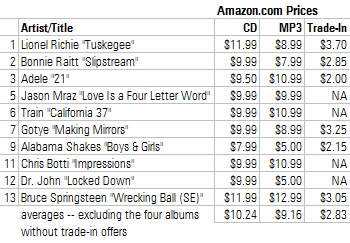
all prices as of 4/18/2012
Of the remaining six CDs, Amazon's current price for the new CD ranged from $7.99 to $11.99, with an average of $10.24. The trade-in offers ranged from $2.00 (Adele's "21") to $3.70 (Lionel Richie's "Tuskegee"), with an average of $2.83. These numbers are all "up to" amounts, however, and assume that the disc and the jewel case are in "like new" condition.
The interface also makes it easy to see the range of prices Amazon's third-party buyer is willing to pay for different releases in an artist's catalog. Again, unlike the prices for new music, here you'll see a great deal of variation. In general, Amazon offers the largest trade-in amount for an artist's most-recent release. And an act's earliest albums, even if they're considered classics, often have the lowest trade-in value. For example, Amazon is offering up to $3.95 for Van Halen's comeback album "A Different Kind of Truth," but just 65 and 95 cents respectively for the band's first and second releases. But that variation just reflects the supply and demand of existing CDs -- the fan base of any given artist is both more likely to already own the act's earliest releases and have more copies of those CDs to sell, depressing the price.
Another obvious trend is that the release of new re-mastered CD decimates the trade-in value of the previous version. Amazon is offering up to $4.80 for the 2009 version of the Beatles "Blue" collection but only $1.50 for the original CD release.
As for those one-cent used CDs you see on Amazon (the sellers actually make their money on a cut of the shipping charges), don't bother -- Amazon doesn't want them. But just because a portion of the artist's catalog is in the one-cent category, it doesn't mean that Amazon won't purchase other releases -- it's offering up to $4.05 for a live Hootie & the Blowfish album, even though it won't purchase the band's best-selling studio albums.
Finally, on a relative basis, Amazon's quoted trade-in amount is the least generous for out-of-print CDs that are commanding high prices in the used market. For example, when checking the trade-in value of Lionel Richie's current best-selling disc, I discovered that Amazon is will to pay up to $5.50 for the soundtrack to the 1981 film Endless Love, featuring Lionel Richie. But the lowest price for the used CD from individual sellers is a whopping $69.39, though who knows how long it'd take to sell the disc at that price!
link 0 comments e-mail listen to the Layaways on Spotify
Follow @digitalaudio Tweet
February 21, 2012
Tuesday Odds and Endsby David Harrell
Is France's "three strikes" law resulting in more digital music purchases?
Studies show that the appeal of piracy has waned in France since the so-called three-strikes law, hailed by the music and movie industries and hated by advocates of an open Internet, went into effect. Digital sales, which were slow to get started in France, are growing. Music industry revenues are starting to stabilize.Apple's size and success has a huge effect on the S&P 500 index:
For all the companies in the Standard & Poor's 500-stock index, earnings are on track to post a 6.6% year-on-year rise in the fourth quarter. Once Apple's earnings are factored out, the expected fourth-quarter gain shrivels to just 2.8%, according to UBS.Fractals and music rhythms -- identifying composers by their rhythm signatures.
And two great bits from some WSJ book reviews: How Henry Mancini learned the value of writing your own songs:
It was a Vegas choreographer who clued him in to the importance of writing his own songs: Arrange someone else's composition and you get paid once; write the original song and every time it is performed or a record is sold you get a royalty.Legendary jazz producer Norman Granz had no problem with "niche" artists:
When a distributor of one of Granz's labels complained that one of his artists sold too few copies, Granz roared that if just 1,500 people wanted to hear the musician, that was enough -- and he fired the distributor.
Labels: copyright, file sharing, music piracy
link 0 comments e-mail listen to the Layaways on SpotifyFollow @digitalaudio Tweet
February 10, 2012
Friday Flashback Fun: Debating Music Sharing in 1978by David Harrell
Long before the advent of music filing sharing, there was the "home taping is killing the music industry" debate. While the head of the European Tape Industry Association was hardly a neutral party, in this 1978 Billboard Magazine piece, Henry Pattinson frames the issue with some quotes that sound very similar to modern arguments about file sharing:
"The British Phonographic Industry has said that $135 million is lost each year through home taping. Now that figure is absolutely hypothetical. It is money that was never spent and there is no way of knowing if it ever would have been."That last bit is a key difference, of course, as music sales were actually growing at the time.
"In fact, the indications are that home taping is most prevalent among age-groups who share records and tape them simply because they can't afford to go out and spend money frequently on new albums."
"Music is one of those things that the more you know about it, the more you want. But if you kill off the interest of young people, you will lose a future generation of adult record-buyers."
"It is clearly demonstrable that the blank tape business, illegally used or otherwise, has improved awareness of music, increased demand and directly stimulated the expansion the industry has enjoyed in the last five years."
Labels: Friday Flashback Fun, home taping, music piracy
link 0 comments e-mail listen to the Layaways on SpotifyFollow @digitalaudio Tweet
February 06, 2012
Buy It, Cherry Pick It, Stream It, or Steal It?by David Harrell
Randall Roberts's review of the new Van Halen album in the L.A. Times does a great job of summing up the choices today's music listeners have:
Now the dilemma isn't just, should you spend money on the CD ($14.99 list price) or a digital copy (also -- frustratingly -- $14.99). It's also, how much are you willing to commit to buying in? Will a few dropped bucks on a handful of the best individual tracks suffice? Or will "A Different Kind of Truth" be the perfect Spotify streaming album, not good enough to pay hard money for but worth a mouse-click when you've got a spare few minutes? Or should you just ask your computery friend to Sendspace you a pirated copy?I'm still working on my in-depth post on Spotify economics, but the above description of Spotify being a "good enough" option for some albums will be a central component.
Labels: cherry picking, music economics, Spotify, Van Halen
link 0 comments e-mail listen to the Layaways on SpotifyFollow @digitalaudio Tweet
January 27, 2012
The Right to Re-Sell Purchased Digital Contentby David Harrell
I've long believed that the pricing of digital albums, with the exception of the sub $5 specials at Amazon MP3 and the cheaper offerings in the eMusic catalog, too often fails to account for the loss of the potential resale value that purchasers of music CDs enjoy.
But from the details in this WSJ piece on Apple's foray into the digital textbook market, it appears that Apple is offering a substantial discount from physical book prices, one that is much greater than that of most digital music:
"It's nothing new," said Gonzalo Garcia, director of technology, marketing and communications for the South Kent School, an all-boys boarding school in Connecticut, though he said the "shocking news" was the $15 price. Currently, students pay $20 to $60 for a 180-day rental or splurge as much as $100 for a higher-end title.Meanwhile, ReDigi has responded to the complaint from EMI Capitol Records about the ReDigi marketplace for used digital music. (A PDF of the ReDigi response can be found here, along with a letter to the district judge who is overseeing the case.)
While I don't have enough knowledge of copyright law to offer any informed comments on the underlying legal arguments, I will say, that as a consumer, I'm philosophically in favor of the right to re-sell legally purchased digital content. And if that right is given up as we move from physical to digital content, the pricing of digital goods should reflect that concession.
Labels: digital music pricing, ebooks, ReDigi, used digital content
link 2 comments e-mail listen to the Layaways on SpotifyFollow @digitalaudio Tweet
January 19, 2012
One Quick SOPA Thoughtby David Harrell
I've mentioned it before, but the one thing that really struck me yesterday was the incredible power/platform that Google's homepage provides. It's something that has to be used sparingly, but Google can instantly air its views or promote a cause without spending a penny on advertising or lobbying. (Though GOOG does spend big bucks on the latter!)
link 0 comments e-mail listen to the Layaways on Spotify
Follow @digitalaudio Tweet
More Digital Audio Insider: Newer Posts Older Posts
Subscribe:
 RSS Feed
Add this blog to Del.icio.us, Digg, or Furl. Follow David Harrell on Google+.
The Digital Audio Insider Twitter feed:
Digital music jobs: Looking to hire? Looking for a job? Check out the digital audio insider job board.
Popular Posts
A Long Tail Experiment
By the Numbers: Using Last.fm Statistics to Quantify Audience Devotion
Lala.com Owes Me Sixty Cents
An Interview with Jonathan Segel of Camper Van Beethoven
Price Elasticity of Demand for McCartney
Sony and eMusic: What I Missed
The Digital Pricing Conundrum series:
Part One Part Two Part Three Part Four
THE LAYAWAYS
Out Now -- "Maybe Next Year" -- The New Holiday Album:
"This is a sweet treat, deliciously musical without being overbaked for mass media consumption." -- Hyperbolium
"Perfect listening to accompany whatever holiday preparations you may be making today." -- Bag of Songs
O Christmas Tree - free mp3 lyrics and song details
Away In A Manger - free mp3
Download from eMusic, iTunes, Amazon MP3, or Bandcamp. Listen to free streams at Last.fm.

"...about as melodic and hooky as indie pop can get." -- Absolute Powerpop
"Their laid-back, '60s era sounds are absolutely delightening." -- 3hive
"...melodic, garage-influenced shoegaze." -- RCRD LBL
Where The Conversation Ends - free mp3
January - free mp3
Keep It To Yourself - free mp3
Download from eMusic, iTunes, Amazon MP3, or CD Baby, stream it at Last.fm or Napster.

"The Layaways make fine indie pop. Hushed vocals interweave with understated buzzing guitars. The whole LP is a revelation from the start." -- Lost Music
"Catchy Guided by Voices-like rockers who lay it on sweetly and sincerely, just like Lionel Richie." -- WRUV Radio
Silence - free mp3 lyrics and song details
The Long Night - free mp3
Download from eMusic, Amazon MP3, or iTunes, stream it at Last.fm, Napster, or Rhapsody.

"These are songs that you want to take home with you, curl up with, hold them close -- and pray that they are still with you when you wake up." -- The Big Takeover
Let Me In - free mp3
Ocean Blue - free mp3
Download from eMusic, Amazon MP3, or iTunes, stream it at Last.fm, Napster, or Rhapsody.
More Layaways downloads:


the layaways website